Showing posts with label gaming. Show all posts

Saturday, 27 February 2021

Reconstructing Fantasy In The MMORPG

Times of great crisis oft call for similarly great compromise. 

Admittedly, as a perennial shut-in, my pandemic compromises have come easier than most. Even as I have dabbled in those hallowed artefacts of the terminally uncool, anime, fan fiction, Dungeons and Dragons and their ilk, there has always remained one avenue that remained beyond the pale: the Massively Multiplayer Online Role-Playing Game, or MMORPG. I vowed to never venture into EverQuest, or be wowed by World Of Warcraft and or to even know enough about MMOs that I could come up with a third example.

That is not to say that I had a distaste for that particular form of gaming. Rather the opposite: I've had a deep fascination for the concept long before ever diving in myself. I've devoured the ancillary materials of MMO culture: Documentaries, such as Second Skin (2008) and Life 2.0 (2010), an episode of South Park that utilised in-game WOW footage to tell its story and followed closely the emergence of Isekai anime; a genre which frequently sees its main characters drawn into a virtual game-world.  

But a monthly subscription fee, not to mention the level of total immersion, was so alien to how I traditionally approached gaming as a medium. Frequenting mostly older titles, my gaming history has been defined mostly by cheaply-procured, second-hand, single-player story experiences to be consumed not unlike a DVD: played through once and relegated to the shelf, never to be parted with for the sake of a replay that will never come. 

Yet still coming down from the Final Fantasy VII Remake high, and with truly nothing better to do, I finally tried out Final Fantasy XIV during (the first) lockdown. Several months later, the plethora of fascinating stories and experiences I've engaged within the Final Fantasy XIV makes it feel that much less like a singular experience and more like an interactive streaming service. With catgirls. The library of which, after half a year, I still feel like I haven't made much of a dent in.

So many of these quest-lines are sweeping and ambitious, detailing their own casts of characters and wondrous locations, yet I was recently floored by something comparatively much more mundane. A feature easily overlooked and in no way unique to this particular game.

Where the FFXIV's second expansion, Heavensward, weaves a complex story of war, dogmatism and colonialism (with dragons!) that ranks alongside some of the franchise's best storytelling, the totally optional, follow up side quests see the player-base tasked with the reconstruction of the post-war world. The once hostile city-state of Ishgard has had a change of heart, and now seeks to do right by its displaced, to refugees and the downtrodden.

Serving as a collective, collaborative mini-game to encourage the game's crafters to compete for prizes and glory, countless players go from supply pile to work station to building site in a frenzied rush to complete construction work within the time limit. The Ishgardian post-war optimism is palatable throughout, as the crowds are staggering and a soaring musical score accompanies the mass building projects. Not only is it the strength of a narrative forbidding economic concerns to inhibit essential investment that is affecting, but the clear enthusiasm also. The player-base could so easily spend its time running dungeons, seeking treasures and hunting monsters, yet would gladly choose instead to build an orphanage.

Naturally, that is a manipulative framing. There is plenty of in-game incentive for the player to do this. Importantly though, this was a moment that transcended any of its constituent elements. This mass building project resonated deeply, reminding me of that hallowed 1945 spirit, where from the desolation of the blitz emerged enough political will to rewrite the fabric of the UK, greatly expanding its welfare state and establishing the NHS. But just as much did it emphasise the chasm between the economic status of then with the post-Thatcher now. I would find myself wondering, do our own politicians require cute pets, cool outfits and themed furniture to incentivise real world rebuilding?

Where the dominant stories of pandemic politicising will rightfully be the apathetic, sluggish responses of a disconnected political class patronising and aggravating their constituents, the pandemic has also seen movement against that aforementioned status quo. Particularly in the urgent housing of the homeless. 

Whilst it would be wrong to characterise this as a universal effect of post-Covid optimism, my university city of Coventry saw almost all of its rough sleepers housed. Long since having moved away from Coventry, I found this out via newsreel and the sight of the city centre, once so indistinguishable from the human pain and misery of homelessness, now totally clear was staggering. It was that rare occasion where a news item rendered me so totally speechless, so moved by the simple, mundane image of doorways with no one lying in them. 

Both that very real, material experience, and the ephemeral virtual one, found its power in a radical simplicity,  offering a break with the dominant common-senses and pragmatisms that dictate that things simply cannot get better. What's particularly interesting in the case of FFXIV, however, is that it is not only this fantasy of remedying real world problems realised. For years now, the game-as-service has been plagued with its own housing crisis, a crisis borne out of not so alien backgrounds: where the few rich players buy up more housing than they need, or can even feasibly use themselves, leaving the many without; demand has far exceeded the supply.

This has had a real human cost, as securing housing in the game has transformed into as much of a real world trial as an in-game one. If the idea of harm seems an extreme one, I would recommend we cast our minds back to the aforementioned documentaries, Second Skin and Life 2.0, and the very real mental and physical damage that can come from these immersive experiences.

In building a new housing district for Ishgard, you are engaged directly with seemingly solving this crisis- even as the underlying problems go unaddressed. Players engage in an almost interpassive experience, where at the point of interactivity, the construction of a new housing district, encourages docile, passivity in a player base that is being actively harmed by the ongoing housing crisis. On the level of narrative response, this plays out as well: the player's resolution of one housing crisis allows for closure and complacency in the face of the other.

Soon, the housing district will be complete. Players will move in, and perhaps the story will contrive itself so as to provide some new location to rebuild. But it was this particular moment that stood out amongst hundreds of hours of gameplay. 

Monday, 22 June 2020

Team Tifa or Team Aerith? Final Fantasy VII Remake Changed My Mind

*Spoilers follow for Final Fantasy VII, Final Fantasy VII Remake and possibly, maybe future instalments of the Final Fantasy VII Remake. I don’t know, I’m not a psychic.*


Aerith dies. Told you there’d be spoilers. 


Still, Aerith dies. It is perhaps gaming’s most infamous spoiler. You will still find people today talking about what a formative experience this was: how it proved the potential of games to tell emotive stories, how it transformed Sephiroth into one of the greatest villains of all time and how you can definitely bring her back, bro, trust me bro, you just have to play her theme on the piano and talk to her ghost in the church and level everyone up past 99, bro it’s true an employee at Squaresoft told me, this method actually works for sure.


The death that once shocked the gaming world simply no longer reverberates for the vast majority of newcomers to Final Fantasy VII. Everyone who has attempted to play the game since 1997 has heard that spoiler by now, and, boy, does it loom heavy over the experience. Experiencing this classic for the first time, Aerith's death comes as more of a relief than anything else: “Finally, now I can get on with the rest of the game!"


In my first playthrough (of many), I had no emotional investment in Aerith. She seemed to fit too easily into that idyllic maiden stereotype which seems to haunt Final Fantasy’s White Mages at their every step: Rosa from IV, Garnet from IX, Yuna from X, Luna from XV and Aerith all seem cut from the same cloth. They’re sacred, morally pure, exalted from birth. Chaste, virginal, bland, uninteresting, bleh.


So, already, you have to question why anyone would put any effort into seeing more of that character. As soon as I was able she was relegated to the back-benches. Practically speaking, this was in favour of transforming Barret into my personal heal slave as quickly as possible. (And, if we're being honest, how much of the emotional weight of her death has more to do with the fact you just lost your best healer?)


But, substantially, this was in order to prioritise the game’s other love interest, Aerith’s rival: Tifa. Now, she rarely left my party. She was treated to my best Materia, she got to go on the Gold Saucer date and you best believe I was getting her that scene under the Highwind. Tifa was the childhood friend. The merciless monk. Sabin suplexed a train, sure, but Tifa suplexed Godzilla. Most importantly, she is cemented in the game’s central character story, that of Cloud’s identity crisis, far more than Aerith is, who represents the more fantastical side of things; the Ancients and the Lifestream and Jenova and all the stuff that went over your head that first time around.


In Cloud’s story, Aerith’s primary function is simply to die. Her secondary function is then a link to Zack, where Aerith likes Cloud because she liked Zack. Cloud likes Aerith because Zack liked Aerith. And then she serves a tertiary function of, maybe, saving the world in a final eco-warrior Hail Mary. Tifa, on the other hand, is the connection between Cloud’s faux Ex-Soldier persona, and his true identity. Far and away, she seemed the more endearing character. And for years I held my head high, wearing my Team Tifa shirt proudly, knowing that I had made the enlightened decision.


That was half a decade ago, and Final Fantasy VII looks decisively shinier now. For one, they’ve added a few more polygons. And Tifa has never looked better. A fantastic design with a real weighty, “punch”y (heh) playstyle. But Aerith’s character is revised too: Flower power Madonna is out, grunge-y manic pixie slum girl is in.


With all due respect to Mena Suvari, herself an institution in the pantheon of teen moviedom, Aerith’s new voice actress Brianna White is a massive factor in bringing about this new, more compelling version of the character. She works within the structure of the original content, where Aerith’s most damsel-y moments are kept intact, but lends them all an ironic flair. Throughout, you do get this feeling that Aerith doesn’t really need Cloud as her bodyguard and, for all the humour, incessant joy and strange anime grunting, there is a bittersweet undercurrent to it all. A sadness that lies just beneath the surface.


Perhaps, this version of the character was there in the original, but such nuance is hard to convey through poorly translated textboxes and minimal emoting. It’s even harder to remember. Remake Aerith has an aura of clarity, certainty and purpose. You’re going to struggle not to remember her personality, and you’re going to struggle not to fall in love with her.


I can’t lie, it helps that she plays like a god. There’s not a video game character more endearing than the one who’s actually fun to play and there are few things more satisfying than finishing off some bandit creep with the aptly divine-named Ray of Judgment; Aerith is responsible for many of the combat’s *Chef’s Kiss* moments.


But it is that iconic death, conspicuously absent from this first instalment, which has changed Aerith the most. For a long time, her death has been a bit of a ‘Women in Refrigerators' moment, motivating Cloud and the player forwards at the expense of her own character. Not any longer.  This new imagining lends her far more agency than she was ever granted before, as certain scenes seem to hint that she knows at least the broad strokes of destiny (IE the original game’s plot) and, as such, is aware of her ultimate fate; alternatively going towards it willingly or attempting to avoid it entirely, depending on how the ‘Unknown Journey’ pans out.


So, there’s a case to be made that Remake Aerith has taken over from Tifa, claiming her rightful place as new ‘best girl’. But that doesn’t really hold up either. Because one of the truly great reinterpretations of the Remake is how it drains away the jealousy and competition between these two characters in order to break away from the confines of their love triangle. Much to the contention of warring shipper factions, this reimagining casts the characters as close friends from the get go, foregoing any pretence of rivalry or jealousy, and they often have more chemistry together than either of them do with Cloud. According to Tifa’s voice actress, Britt Baron, this interpretation of their friendship specifically shows that “women don't have to tear other women down”, but, more than that, it reads as a denial of the love triangle’s foundational status in the legacy of Final Fantasy VII: these characters are bigger than Cloud now. They have lives that do not completely hinge around his existence.


The Tifa/Aerith rivalry is then rendered a relic from a bygone era of internet fandom, sat perhaps alongside anonymity and CreepyPasta, and whilst I have some sympathy for those brave soldiers trapped in the unending shipping wars for upwards of twenty years, the Remake has breathed new life into these women.


Rather than needlessly relitigating old arguments over which female character is better (which curiously all inevitably descend into gratuitous comments on cup size), we can perhaps look forward to some more fruitful discussions about what makes both of these characters so enduring, twenty years after their debut.


Oh, but Jessie is definitely ‘best girl’. Just saying. 


Sunday, 26 January 2020

I Played Kingdom Hearts 3 And Then I Cried And Then I Wrote About It

In school, I was a massive, embarrassing crybaby. If someone looked at me the wrong way, if a teacher shouted at me or even if I just wasn't receiving enough attention that day I was liable to burst into tears. Yet, for all that sensitivity, I rarely cried at movies. Or books. Or music. Or video games. I didn't really laugh along with comedies and never found horrors all that horrifying. And whilst I still had a deep love for the stories I engaged with, that love was logical and cold. More obsessional than sincere.

Nowadays I cry about 'real' life considerably less. In those terms, in matters solely relating to my own personal experiences, I can think of just one time I was reduced to tears in the past five years. And I was drunk, besides. It would seem that maybe I've totally closed myself off, or gone numb, or just finally grown up. Yet those tears do still come. Only now it is the slightest moment of sentimentality in an episode of The Simpsons that can have me blubbering for minutes on end. Some of the moments when tears have decided to flow have left me incredulous; seemingly mundane, unimpressive shows of hope, optimism and love.

Recently, the media experience that affected me in such a way was during my play-through of Kingdom Hearts 3. I was roughly a year late to the party, but still found myself moved by its sincere performance of the inner goodness of all, the possibility for everyone to be redeemed. Reflecting back, it's almost a sickly sweet idea. But, hey, it worked at the time.

As it turns out, brutal authenticity is the theme of this post.

For those who don't know, the Kingdom Hearts franchise consists of a video games, movies and complex depicting a crossover between the intellectual properties of Square Enix and Disney. Angsty emo teens partake in anime-esque battles alongside Donald Duck, Goofy and Mickey Mouse. It is exactly as absurd and surreal as it sounds. It is that precise absurdity that places the series as a premier space from which to unpack nostalgic sentimentality; this is a franchise most shrewdly and conspicuously designed for you to purchase your childhood back. You might go as far as to say that Kingdom Hearts is one of the preeminent commodities of postmodern capitalism, but people would probably call you boring if you did so.

Throughout the game, you play as Sora, or some other spiky-haired protagonist, chasing after an ill-described macguffin (In KH3, this is the 'power of waking', which apparently isn't just an alarm clock) through the worlds of different Disney movies. Your true goal, of course, is to make the casts of these films happy. It is a simple joy. Dance with Tangled's Rapunzel, take selfies with Toy Story's Buzz and Woody, inexplicably yeet yourself off a mountain because Elsa told you to and so on. The game empowers you to fulfil the happy endings of the movies you loved growing up.

A scene from Kingdom Hearts 2 depicting what I can only describe as 'Goth Mickey'.

So it's a deeply nostalgic experience and its emotional resonance seems indubitably rooted in that nostalgia. Only here we hit upon a certain complication. I wasn't a Disney child. I wasn't even a Kingdom Hearts or Final Fantasy child. The vast majority of this content I only experienced for the first time two years ago. It may well be nostalgic. But it isn't for me. So why did its follow-up garner from me such a visceral, emotional response?

Of course, no doubt part of it was down to the craft of the game itself. It is good. Really good. The music is heavenly and the fact that the ostensible third game in the series is actually something like the ninth does hold you somewhat emotionally hostage. But that aforementioned delight in optimism, the joy of experiencing a happy ending for a change (you will note that I am writing a blog post about a video game, and not the ongoing Labour Leadership Election), still stops somewhat short of an adequate explanation for me. I feel that it is in the delivery of this sentimentality as much as the message itself. Similar to the viewing of Disney movies themselves, playing Kingdom Hearts is a practice in infantile regression. In that the player willingly takes on the role of a childlike actor and experiences nostalgia not in the literal sense, but as a genre unto itself: we aren't so much feeling the pain of a past that we can never return to, so much as we are entering into that past for the first time.

And is this nostalgia genre not what we are endlessly barraged with, in multiplexes and on streaming services? Texts we know are nostalgic before we partake in them, concerning brands and experiences that we have no investment in. It seems that a key feature of nostalgia today is that the nostalgic text professes to exist, regardless of your own personal investment in it. Perhaps, Star Wars was the seminal moment for this genre. Perhaps this is some inherent form of human storytelling. Still, I think most of us can tell there is some difference between George Lucas' nostalgic pulp space opera and J.J. Abrams' Star Wars by way of Star Wars. 

Whilst I'm not interested in blanket-disparaging escapist fantasy, there is a danger in this wider nostalgia-qua-genre, both in that it's a creative dead end of glorified reruns and in that nostalgic experiences like KH3 are perhaps too sweet, too optimistic, provide too much hope. These are naturally not inherently bad qualities, but in so far as that these sentiments are directed not towards our future lives, or our present conditions, but to our non-existent pasts, they keep our imaginations dull and limited: to hope is the infantile fantasy of Disney movies and video games.

I'm now posed with the exceedingly difficult question of how to end this blog post without adulating the inherent cynicism in these products, without talking down, even betraying, my own personal experiences. Sure, I could lie and say that I've only ever been moved by old social realism films, and that cheap sentimentality produced by unconquerable media corporations has no effect on me, but what would be the point? Instead, I think I'm just going to go and cook a meal with my friend, Remy. The rat chef. From Ratatouille.

Tuesday, 12 February 2019

Post-Nuclear Utopia: The Fallout Franchise and Its Ultraconservative Appeal

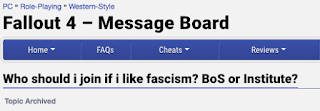
Considering Bethesda's loud and proud anti-nazism marketing campaign for its alternate-history first-person shooter Wolfenstein 2, it's interesting to note that the fanbase of another of the company's major franchises, Fallout, is ripe with right-wing rhetoric, ultra-conservatism and, yes, fascism. That is, the same hyper-nationalist, white-supremacist fascism that was decried in the Wolfenstein 2 campaign. The Fallout game-franchise is, then, the backdrop for another round of the ongoing culture wars; the first step in unpacking the franchise's appeal to the ultraconservative is to isolate its origins and then to ask to what extent does Bethesda's own work account for this extremist fanbase.

For the unfamiliar, the Fallout franchise sets role-players loose into a retrofuturistic, post-apocalyptic America. Starting out in isometric form in 1997, the series would jump between developers and publishers until it was realised, in its current, recognisable form, as an extension of Bethesda Game Studios' first-person, open-world game design philosophy- a science-fiction counterpart to the Elder Scrolls' immersive fantasy experience. With the latest entry, Fallout 76, released on November 18th of last year, there has never been a more poignant time to imperil Fallout’s ultraconservative appeal.

The franchise tells satirical narratives of the future, with the “76” in Fallout 76 referring not to 1976 but 2076, and these narratives are often satirising conservative politics and lifestyles; suggesting that all a conservative mindset can give to us is the apocalypse. When we question why the Fallout franchise can seem so accommodating to audience’s who would, on a surface level, appear opposed to the game’s, and its developer’s, expressed values, we can see a few potential answers staring back at us. The first is simple: gun fans like gunplay. On a ludological level, Fallout’s lone-wanderer-with-a-gun approach to game design resonates with a subgroup of gamers who have an active interest in firearms, along with small government political policy; the open world allowing the player to enjoy the fantasy of a nomadic, libertarian existence. Yet, this reading is painfully myopic, on account of the wider, cultural appeal of gunplay. Naturally, there is a strict role of guns in the formation of the modern conservative identity, but gunplay in games is enjoyed across a vast swathe of fan subgroups and, certainly, conservatives have no monopoly on firearm fanaticism. So we are obliged to look beyond this and, when we do, we can see that actual conservative spaces have been carved out within Fallout fan communities themselves. I assert that this particular fan space exists, not due to the text, but in spite of it.

In the case of the open world's inherent appeal to far-right gamers, we see a selective enjoyment indicative of the wider ironic detachment that characterises not just engagement with Fallout, but with engagement throughout the digital era. Whilst the conservative reads the lawless wasteland as a reflection of policy and an idealised storyworld, they can simultaneously detach themselves from the deviant sexualities and lifestyles that make themselves present in the game and which run counter to their worldview. This is prominent in conservative fan assembly around the term, “degenerate”, used by in-game characters (and game director Todd Howard) to deride unsavoury storyworld elements. Accommodated by the in-game factions and multiplicity of in-game ideology and identity, any gamer (not just the ultraconservative) can engage with every constituent element without feeling that any one has any meaning outside of its fictional habitat.

There’s a prevailing belief that one can engage, ironically, insincerely, with every element of the digital era and this has incubated the normalisation and legitimisation of increasingly reactionary viewpoints. On the alt-right, Dr. Alice Marwick has said that “irony allows people to strategically distance themselves from the very real commitment to white supremacist values that many of these forums have”, which particularly rears its head with Fallout’s beloved fascist faction, the Brotherhood of Steel. To engage, ironically, with Fallout is to engage unironically with its satire. This, in turn, accommodates an unironic, unironic engagement, as an (reactionary) audience can only then read Fallout sincerely. They can read the promise of post-nuclear freedom and renewed Americana as part of the franchise’s brand, disregarding any subversive affect its creators may have intended.


The dissonance between conservative engagement and a proposed satire of conservatism, then, actually matters little; intentionally or not, Fallout’s constant negotiation and renegotiation of meaning allowed the creation of a space that could be filled by the ultraconservative and the hypernationalist. This though begs the question, where did the right-wing elements come from to fill this space? What is it about the world of Fallout that is so appealing to them?

Retrofuturism, a term used to describe the utopian fantasies of the futures of yesteryear, is perhaps the crux of the question around Fallout’s conservatism. In retrofutures, we see again the science fiction iconography that went hand-in-hand with that era; for the 1950s this included jetpacks, flying cars, homes of tomorrow and so on. Remnants of Fallout’s retrofuture are seen scattered across the wasteland, the abandoned vaults with every Cold War styling and amenity are littered with “Mr. Handy” servant-robots (and even the aliens of the franchise are more reminiscent of Roswell and UFO fervour than any other sci-fi touchstone), but the post-war, post-apocalypse has little to offer in its longing for yesterday’s future. It is in specifically pre-war sections of the game (flashbacks, simulations and the ilk), which are not the franchise’s focal point, where the retrofuturistic conservatism shines through.

As each new entry to the franchise gives an obligatory return to the pre-war retrofuture of the 2070s, Bethesda Game Studios reiterates a prognostalgia, a sincere sadness for a future that never came to pass, which characterises the rest of the game. This is seen in Fallout 3’s opening, where the main protagonist grows up in a time-capsule-like vault, and its sequel Fallout 4’s also, where the main character was present in the nostalgic pre-war era. Whilst other studios working on the IP forsook such direct flashbacks, Bethesda Game Studios weaves this sombreness, this regretful tone throughout the experiences of both games. This gives way to the accommodation of what I call the myth of Fallout. Rather than a legendary myth, this is a myth of the Barthesian sense, where in which the nuclear fallout depicted in the game is not the end of the world, but instead a rebirth of conservative politics. The promise of this myth is that, after the bombs fall, the nostalgic, conservative past will be returned to us, imbued with new vigour to pursue the same American ideals and dreams as ever.

No aspect of the game series encapsulates this renewed, militant Americanism like Liberty Prime; a pastiche “Iron Giant” who foregoes anti-militarism and anti-nuclear sentiment for an uncritical adulation of “democracy” and American capitalism. Liberty Prime, appearing in Fallout 3 and Fallout 4, is shown as an imposing, if retrograde, American military marvel. Like any good American soldier, he is deeply patriotic, spouting anti-communist slogans and propaganda akin to what may have been heard during the Cold War. It’s even wrong to call the giant robot an instance of nuclear deterrence, as he hurls miniaturised atom bombs at his enemies. As metallic shouts of "Death is a preferable alternative to communism," ring through the battlefield, the robot exists as the zenith of Fallout’s retrofuture; a technological marvel constrained by the hatred and prejudice of its time of creation. It is, then, noteworthy how beloved the automaton became. Not as a criticism of myopic Cold War militarism, but as a sincere, bastion of libertarian values. Even now he is a touchstone for the reactionary, the ultimate vindication that their reading of Fallout is the right one. Take a look at some fan commentary from a YouTube compilation of Liberty Prime quotes:


Not only is the line between fiction and reality blurred, with desires to see the giant robot crush the enemies of fascism, but so is the line between satire and sincerity. In the unironic, uncritical responses to characters such as Liberty Prime and storyworlds like Fallout, we can see that the transformation of democracy from a rule of government to a set of intrinsically American values and beliefs has abetted the anti-democrat to take the violent pursuit of "democracy" into their own identity. As Liberty Prime would declare, "Democracy is non-negotiable," and now is a broader referent, one that encapsulates the American project as a whole. Fascism may be anti-conservative, in that it doesn't seek a return to the past but a rebirth based on past iconography, but it is that very distinction that attracts the ultraconservative and the fascist alike. Fallout's promise of a nuclear apocalypse which ushers in traditional values exists as both a return to Cold War Americana and a rebirth of the nation state, allowing a ground zero from which fascistic imagination can play.

The idealised past (that of course never existed) is revisited, in Fallout, in a form of perverse utopia. The ultraconservatives find, in Fallout's wastelands, a utopian world, free from the constraints and responsibilities of our present one. We can see this idealised past again, throughout the franchise’s Americana aesthetic. Particularly, the music creates a strong sense of nostalgic longing, but not for the in-universe character. These songs, famous jaunty pop tracks from yesteryear, are nostalgic for a prior state of the world. A world promised to the ultraconservative player, after the bombs fall. With Fallout 76's promotional material, merging The Ink Spots’ "I Don't Want To Set The World On Fire" (popularised by Fallout 3) with John Denver's "Take Me Home, Country Roads", we can see that the anachronism (Denver's song was released in 1971, long after Fallout's 50s point of reference) means nothing. The music is not representative of the world's past, but rather our world's past which is, in turn, this world's present. The themes and tone of Denver's song are no coincidence either; a classic country song ushering you back to a vague notion of home; communicating the idea that the world offered in Fallout is a home, of sorts. One which appears as a safe space for the moral workings and philosophical lenses that no longer seem to have such a home.

As opposed to most retrofuturistic narratives, the core of the Fallout franchise actually affords us an element of subversion, threatening to turn the conservativeness inherent to retro on its head. We are brought into a storyworld where every American imagineer had their dreams fulfilled, where conservative social values (like the nuclear family and white suburbia) remained unchallenged, and yet this can do nothing but yield armageddon. The question of why Fallout’s future is so 50s referential, in particular, has been bounced around for a while, but I think I finally have the answer. The retrofuture isn’t merely a representative of an uncritical, happy time that can be universally enjoyed before the horrors of nuclear war takes it away; the retrofuture tracks a specific narrative, one where social values don’t accelerate to keep up with technological progress. It condemns retrofuturistic ideals specifically by having the outcome of their implementation being a nigh-total apocalypse. Why the 50s? Why invoke the imagery, language and iconography of Cold War? Simply, because it can be nowhere else. The unabashed Space Age optimism running alongside profound domestic and international anxieties in Cold War America is a duality that can not be undersold. To turn the retrofuture against itself, Fallout pushes this duality to its final, deadly conclusion.

Fallout, though, can never seem to outrun its sincere readers and perhaps this is because its very nature as a video game denies any definitive communication between authorial intent and an audience reading. This is, of course, only exacerbated by situating it in the open-world, role-playing genre. It may be the case that this openness is going too far for a developer to manage. You cannot simultaneously offer freedom of choice and effectively communicate a singular message or cohesive world.

So, to some, Fallout's wasteland is a utopian dream of rebirth, tapping into the spirit of manifest destiny. America, after nuclear war, can once again become the new frontier, pursuing a patriotic endeavour for a future characterised by its past. Whilst I’ve expressed that this is a counter-reading of the text, it is worthwhile to examine the culpability of Bethesda in the curation of this perspective. With Fallout 76's recent launch, a game that promised to transition the series from retrofuturistic satire to post-apocalyptic fun with friends, we cannot just assume that Bethesda has experienced a “death of the author” moment and lost all control over their text. Rather the commitment to apolitical, open design has cultivated this ambiguity of meaning in order to fulfil its escapist promise and to ensure a cross-political appeal.

Bethesda operates within a political vacuum, arbitrarily flitting between political statements so as to best sell the latest product. Wolfenstein played into antifa, "bash the fash", imagery in a sensational, timely campaign, yet The Elder Scrolls V: Skyrim (and, as I’ve laid out, the Fallout franchise) has intentionally curated appeals to the far-right, ultraconservative. White nationalism and imperialism are a window dressing Bethesda Game Studios often deploys uncritically, leading to a perennial contradiction between the proposed corporate ethos and the actual corporate product. Game franchises such as The Elder Scrolls and Fallout, which promote player choice and determination, simultaneously depoliticise and construct an in-game political sphere from which the player can act out political conflict with a sense of ironic detachment. There is no right-wing or left-wing, but Stormcloak and Imperial or Brotherhood of Steel and Railroad.

The trailer for Fallout 76 has currently amassed over 32 million views on YouTube and moves the subject of the franchise away from the conservative satire of previous entries, declaring in no uncertain terms that this latest franchise entry is about rebuilding America in the image of its idealised past. It seems that, on some level, Bethesda are embracing their nostalgic, hyper-nationalist base. There are, of course, always extremists willing to take counter-readings of popular texts. There is always a reactionary community that will contort and contrive to find representation or legitimisation from popular media, seen ever since the internet's very first hate sites. This, however, should not absolve the product that makes such entities feel welcome. At the very least, they should be interrogated. Fascism makes alliances and, in American fascism, it makes alliances with the traditionalist, the nationalist, the militarist and finds financial backing in big business and wealthy elites. For a long time, the perception of gaming as juvenile has absolved this particular industry of meaningful criticism. But, when we can see the conservative coalition forming around media products, we should not take that as an inherent reality of the form.
Thursday, 26 July 2018

FFXV's Royal Pack: Facing The Dangers Of "Games As A Service"


Released to coincide with the release of Final Fantasy XV’s PC edition in March of 2018, the Royal Pack downloadable content is the apotheosis of XV’s bizarre, and often disjointed, approach to post-launch content for a single-player game. The fifteenth mainline entry of Square-Enix’s storied Final Fantasy franchise was a divisively modern and unconventional JRPG. Despite launching with the intent to appeal to both new players and long-time fans, XV proved so unpopular with those fans who had numerous preconceptions of what a Final Fantasy game should be that each piece of downloadable content has sought to resolve the criticisms held by the core fan-base. This featured everything from extended narrative sequences to a plethora of combat extensions and, as the content plan has progressed, the changes have become more and more profound. The Royal Pack, and particularly the changes to XV’s Chapter 14, is the culmination of this.

The expansion to XV’s final dungeon does not only add optional content (though it has this in spades, featuring vehicular exploration, side-quests and a new super-boss), but makes fundamental changes to the tone, pacing and even story of XV. These changes expose the poorly conceived post-launch content plan, as each instance works individually but, when combined, fail nonetheless. The new “Rulers of Yore” boss fights are some of the games best, featuring some fantastic music and well conceived quick-time events, and it’s hard to shrug off the other gameplay enhancements (the scale of the City of Insomnia is particularly pleasing). The additional character crescendos work similarly, as each party member gets a “Ruler of Yore” boss to defeat of their own, and these prove necessary to cap off their inclusion in the game as main, playable characters. But, the game wasn’t designed with these instances in mind and it shows. Retroactively adding content to the chapter affects its tone and continuity, as characters transition from sombre to melodramatic seamlessly. The Royal Pack content sticks out blindingly and appears to have been implemented with very little care. Adding a new boss fight between the party’s entry of the citadel and exploration further in leads to the party’s odd exclamation that the room is lit up, long after first entering.

The original XV has, what I feel is, one of modern gaming’s finest endings. It’s sombre, regretful and often feels like a counter to the conventional JRPG ending, which requires incomparable action feats and melodramatic character exclamations. That one of XV’s most powerful scenes is a man struggling to express his emotions to his friends around a campfire highlights the uniqueness of vanilla XV. The Royal Pack content runs antithesis to this, with party members who no longer look, talk and act like the genuine people we had previously enjoyed in the rest of the game. Even when the game provided a fantasy setting, just with cars, the party fulfilled the promise of a “fantasy based on reality”. These melodramatic reimagining’s of the characters which we see in the new Chapter 14 are not only at odds with the rest of the chapter, but with their appearance in the game itself.

It’s not only the characters who are more melodramatic and conventionally ‘JRPG’ either, the relentless boss fights and cinematic moments dilute the special moments that were already there. An addition of Lunafreya and the host of Summons (in-game deities) removes the thrill of seeing both Lunafreya again and the debut of Bahamut, most powerful of the Summons, as he had already showed up in this additional sequence. It shows in actual gameplay, also. With the transformation of a generic encounter into the cinematic Cerberus boss, the already present Ifrit boss, three new “Rulers of Yore” encounters (The Fierce, The Rogue and The Mystic) and Ardyn’s final boss, the Chapter 14 pacing is completely transformed. No longer is there a sombre, regretful walk to your final encounter, its place is taken by bombastic action; there’s no anticipation in the Royal Pack Chapter 14, only the next set piece.

It becomes clear that the Chapter 14 expansion became more about the transmedia Final Fantasy XV Universe than the game itself, working primarily to embed Kingsglaive (the CG prequel film) and Comrades (the multiplayer expansion) into the universe some more. Monsters and themes of Kingsglaive are suitably realised in the expanded dungeon, whilst you can also encounter the player’s custom character and others from Comrades. The failure of Comrades was in its fundamentally misunderstanding of the appeal of XV, creating a dark, bitter world, with no exploration or character, for its multiplayer mode and it is this misunderstanding of their own product that has caused such a tumultuous post-launch content plan to take hold.

So, why, months after release, is it critical to imperil XV’s Royal Pack? Simply, the post-launch meddling sets a concerning precedent for live-service single player games. The original Chapter 14, as it stands, may never gain the benefit of hindsight or any future reconsideration. To question the archivist, which goes in the vault: the Day One Edition, the Royal Edition or both? Those who have paid for the Royal Pack content have a perfectly functional game transformed into something new, whether you feel it as a lesser experience or not. Here, the consumer is paying to have a product renovated according to populist whims, with currently no option to experience the vanilla version (particularly on PC). This brings into question the entire notion of video games as a storytelling medium; are they to tell the stories developers want to tell or stories that fans want to experience?

Final Fantasy XV is arguably the biggest “live-service” single player game we’ve so far seen, which is why the post-launch content has often felt so strange. It’s really the first of its kind. The story is now developed according to the whims of service payers, leading new additions to be implemented in an incongruous and unfocused way. This is important to note in the context of live service multiplayer games damaging interest in single player games (or, at least, the belief of developers that this is the case). Already we have seen a transition towards open, sandbox single player game design, foregoing linearity in exchange for potential Twitch popularity. XV is the next step in this development. It may have been a hybrid live/conventional dlc model (XV had no lootboxes or microtransactions, operating its service on sales of a Season Pass), but the Royal Pack content exposes the future of single player games that attempt to emulate it. For future development of “live” single player games, the lessons on this subject are all to be found in the fraught (and on-going) history of Final Fantasy XV.


Tuesday, 16 January 2018

On Final Fantasy XV's Royal Edition


'Final Fantasy XV: Royal Edition' was announced today as the 'Game of the Year' style collection of the main game, all previously released downloadable content and a wealth of additional extras. In addition to the already impressive amount of post-launch content and updates, there are exclusive features such as quests, an expanded map locale and new mechanics that are included in this new edition or with a 'Pack' that can upgrade your base game into the new edition. Quests to improve the implementation of the Regalia Type-D, an off-road vehicle introduced somewhat clumsily in a previous update, are really welcome and, whilst it being tied to an accessory is somewhat disappointing, the new 'Armiger Unleashed' update looks fantastic. There is also a first-person mode, coming across to the console editions from the forthcoming Windows Edition. There will also be some new lore details and trophies included, however, the main appealing content here is the Royal Vessel and Expanded Insomnia Ruins map.

Below is the trailer for the 'Royal Edition':

https://youtu.be/lPHypsuXNKs


The Royal Vessel is a much more low-key exciting feature than the other things included, particularly in the face of a much more realised city of Insomnia, but has an incredible amount of potential. More so than the expanded Insomnia, this new feature will add to the core appeal of the game. The road trip with your bros feeling that permeates the majority of the game's content is fully focused on here. Including new fishes, new dishes and expanded exploration out on the world's sea. I may be being somewhat optimistic here, but this could be a gateway to a Niflheim expansion later down the line. This is unlikely, as I expect Niflheim to remain a mostly linear experience even after the post-launch work is complete, but I think this is the kind of world most fans are invested in. The game's world map is huge, but it isn't all encompassing, rather it often feels like you're exploring a much smaller area than you actually are because of how little scope there is. It's an interesting duality between that scope and the value of detail, FFXV, at launch, focused on the detail, leaving some fan's disappointed that the exploration of a fully-fledged game world never manifested. The Royal Vessel, using a boat to explore the waters between Caem and Altissia, is also exciting to me because it was something I had asked a question about in a survey about FFXV way back in early-2017. My idea for it, however, was nowhere near as ambitious as what this iteration appears to be; I merely wanted to be able to take the boat on its guided track at will.

Expanded Insomnia Ruins is clearly the most exciting content here though. It is the content that is spurring up the most discussion and seems to be where a lot of effort has been invested in by the developers. Chapter 14 was already my favourite chapter in the game, having no personal qualms with the amount of time you spend in the 'World of Ruin', but now it's set to become even more dense. I must confess to some nerves with the developers going back and messing with one of my favourite parts of the game, frankly the entire chapter is one of my favourite game finale's of all time and I have some concerns with regards to the pacing and how this expansion will affect the game from after you go through the citadel gates, but this is overall exciting. More story content, featuring an older Cor, the nefarious Ardyn and what appears to be an apparition of Lunafreya is inherently exciting. Whilst I never felt Ch.14 needed more, the chance to explore Insomnia at large is just tantalising. The small glimpse of it we had in the main game actually had a fair bit of depth to it, featuring a lot of easter eggs and unique party dialogues that really rewarded exploration. The level of detail is something that, no doubt, will be given up in exchange for a much larger area to explore. Losing a comprehensively detailed moment in the story in exchange for a less detailed, but more expansive version of that same moment feels like a fair, if unfortunate change. I have no doubt that the portion of Insomnia explored will remain, my fear is more that, in relation to the other areas, what was once comprehensive will be unable to make up for a wider sense of lacking. Despite this concern, just the idea of an increase of content in XV's coolest, most definitive location is driving me wild.

The new boss fights featured look incredible. Both visually amazing and lore-friendly, Cerberus, Omega and the Rulers of Yore promise to really give players, (like me) who have long since seen everything the game has to offer, a reason to return in force. For new players, I can only envy the journey they are about to go on. Whilst I wouldn't give up the year I've spent in the FFXV community, experiencing all the highs and lows that came with it, new players, particularly on PC, will be able to experience one of my most beloved games in a glorious new state. The Rulers of Yore section shown though is where my concerns for pacing have manifested, yet there's a lot to unpack in the very short clip we saw. Straight away, we see the added boss fights taking place inside the Citadel. This is an area only accessible after the Ifrit fight, providing a slow, sombre walk-up to the final encounter with Ardyn. It is a marvellously well done segment and not something I'd like to see thrown away for the sake of these boss fights. Whilst it initially seems like I just need to deal with the fact that this is how the game is now, there is a small detail that gives me some semblance of hope.

Noctis' cape.

While this may seem the nitpickiest of nitpicks, in the Ifrit boss battle Noctis' cape very noticeably catches fire. The majority of the cape is no longer there when the party ascends through the citadel, posing the question: how come it is there in full in the Rulers of Yore fight? This could imply a few things. My reading is that this is an optional sidequest, either taking place in a similar looking area or the same area through some reality-bending magic (we see the world start to break down in the background. However, we do still see the main quest "The Cure For Insomnia" in the upper-right corner. So this is clearly very confusing, it's certainly unclear just how this fight will manifest in the game itself. It's possible that, of what we see in the trailer, more is part of Comrades than we'd like to think. As Noctis, Gladiolus, Prompto and Ignis have all been confirmed to become playable in the multiplayer expansion, it's possible that Insomnia could be opened up as part of that expansion and not the main game. Certainly the character-creator-styled Kingsglaive we see in the trailer hint to this. That is a key question in the run-up to the release, as the debate over pricing will certainly transform if we learn that much of the content will manifest in Comrades, and not the main game. I do think it's unlikely, as the story content we've previewed seems much more in line with FFXV (the UI particularly looks exactly like the main game) rather than Comrades, but, the problem lingers; returning players just don't really know what they're paying for.

This is currently one of, if not the, biggest discussion points surrounding this edition. The 'Royal Pack', that will allow owners of the game to upgrade to the 'Royal Edition', is supposedly around £20. Now, Square Enix have since come out and said that the pricing of the pack is still in flux, but for the short amount of time before that there was some really intense debate around forums and social media on whether the pack had been priced fairly. There was a sense that comitted fans are being made worse off for purchasing and playing the launch version because the game at launch, season pass dlc and 'Royal Pack' would add up to around £100, compared to the 'Royal Edition's about £60. It was clear that there would have been a 'complete' edition, compiling the main game and dlc, somewhere along the line from the season pass announcement, but, because this edition doesn't seem to mark the final piece of post-launch dlc (Director Hajime Tabata having mentioned a desire to produce Ardyn and Luna themed content pieces) and features exclusive content beyond the season pass, fan nerves are being tested.

From what we can see in the trailer, it's hard to tell whether the 'Royal Pack' is priced fairly at the £20 mark or not. The collective response has been that it is too much, but I do think there are ways it could justify that price, even if these ways seem to be particularly unlikely. For one, the bosses we've seen already exceed the standard for the episode dlc format, indicating that the map expansion could be an expansion comparable to Comrades. With sufficient story backing and the openness of the ocean, this could justify that price tag. It could also be that the pack will serve as the second season pass, allowing purchasers of the pack access to newly released episode dlc. Yet, if more dlc is produced and charged for, will this not undermine the very nature of this riff on a 'complete' edition?

There are many questions as we move forwards to release, but much of this discussion is undermined by what seems to be a Square Enix backpedal on the pricing. When we know the final price, we'll be able to resume discussions on value and whether the content is worth the price. I'm uncharacteristically optimistic that the final price will reflect the content included, based on how the previous season pass dlc pricing was very fair. Overall, I think this new content looks incredible and I'm very excited about it. Critical as I am about the seemingly high price tag, when I first saw the announcement trailer my eyes lit up and I was ready to pay full price to get to explore more of Insomnia, to get more story content and ride in a boat with my bros. Final Fantasy XV remains one of my favourite games of this generation and the post-launch support has me falling in love with it over and over again.


'Final Fantasy XV: Royal Edition' launches 6th March, 2018.