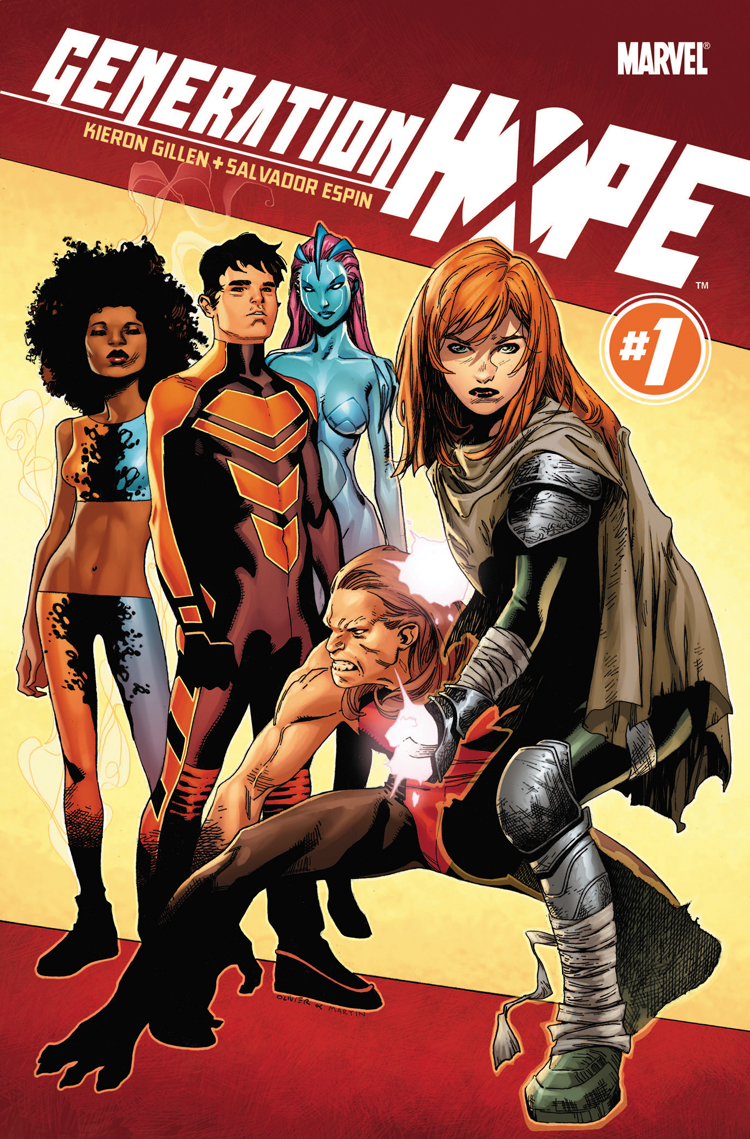
Spinning out of X-Men: Second Coming, 2010's Generation Hope took to focus the first new generation of mutants since the Scarlet Witch, and editorial decree, informed the X-Men of their obsolescence. The line of X-Men titles had been reeled back from its heady heights of 90s popularity, and in-text the mutant population had been severely diminished. This book, and its cast of new characters, set out to define what a modern mutancy could look like. Instead, its post-postmodern superheroes were never permitted the freedom to explore or evolve their unique standing.
Generation Hope #1 By Kieron Gillen and Salvador Espin
The Marvel superhero has been a site of postmodern self-referentiality since its inception, pushing the boundaries of genre and coating itself in a costume, not of spandex, but of ironicism. It's fitting, then, that Generation Hope's attempt to rekindle that same creative spirit went even further into the depths of this self-referentiality. Mutation in the X-Men franchise is the most undiluted, pure realisation of the superhero genre icon of the Power. No complex origin story, no radioactive spiders or enchanted hammers, if you're a mutant you have mutant powers. Rather than delve into the infinite creative potential of this, Generation Hope focused in. choosing instead to pilfer mutations from genre history and develop them towards more traumatic conclusions.
Oya was equal parts Iceman and the Human Torch, taking heat with an ice hand and returning it with a pyrokinetic one. A character based on the two ends of an extreme binary. Velocidad, meanwhile, was functionally a speedster, not unlike Quicksilver or the Flash, differing in that he increases the time around him. The faster he would go, the faster he would age. Transonic's active ability of flight was amplified with shapeshifting characteristics, as her outward appearance invoked the naked blue of Mystique and the blue lips of Apocalypse. Primal spoke to the savage types, the Beasts, the Hulks and the Wolverines, and was particularly concerned with the genre trapping these characters repeatedly find themselves within. The honour of man brought into conflict with the beast within, only this time the beast would win out over the man. Kenji Uedo, codenamed Zero, was perhaps the team's most inventive creation- that is, if you had never seen the film Akira (1988). A unique enough immigration, the character itself nevertheless remained entirely a visual retread of the film's Tetsuo. And then there was the titular Hope, herself a riff on the staple X-Book power manipulators, such as Rogue, Synch and Mimic. Not to mention evoking other cosmically-touched redheads.
Generation Hope #5 By Kieron Gillen and Jaime McKelvie
Where the powers are developed from the base of what went before, they enter into a zone of criticism. Not just of tired, archetypal power-sets and genre imagery, but of character tropes as well. Exemplifying this, a certain aspect of Hope's power set that often goes unremarked upon is her inclination to inspire loyalty and camaraderie between strangers. Rather than a result of charismatic personality, this is inexorably linked with her superhuman abilities; she can awaken and stabilise both the condition of mutancy and the psyches of mutants themselves.
Those following the current X-Men line should note a connection between this unexplored hypnotic element to her powers and the surprisingly close coalition of mutants at the core of Krakoa's state infrastructure, the Five. It also shines a different light on Nightcrawler's Second Coming sacrifice.
But, in the context of Generation Hope, this works more to address practical concerns. It is of little surprise to any follower of comic books when a new team of superheroes debuts, spending the first 6 issues of their series assembling the team and finding themselves cancelled at issue 10. Generation Hope itself would be cancelled at issue 17, albeit with writer Kieron Gillen leaving after 12. With the cast hypnotically under Hope's control, Gillen was able to bypass a lot of the standard storytelling pitfalls in order to deliver his story more efficiently.
Still, however unintentional this may be, the hypnotic aspect nevertheless serves as criticism of the structure and standard of the superhero team more widely; the suggestion being that, if it's happening with Hope's team, who is to say that it is not happening to every cast of superheroes? So often does a superhero team consist not of people who would understandably collaborate for a set goal, or even work against each other as a compelling cast, but of people simply grouped together as alternate sub-franchise mascots. The Avengers come to mind.
That Gillen is never given the opportunity to delve into these concepts further is the series at its most meta. Much like the tragic Velocidad, the story moved faster, burned brighter and ended sooner, with its cast relegated to obscurity almost immediately after cancellation. Touted as the "most important X-Book in years," Generation Hope has, in fact, managed to become little more than a footnote.
New Mutants, in the immediate collective response to its release, has been plagued by one thing above all. Not the oft associated delays, but instead with the question of adaptation. Adaptation is a difficult topic to discuss. Personally, I find that adaptation is a futile lens through which to analyse a film. More often than not, we should look to the meaning of the film as its own text and take it on its own merits. However, especially in the superhero genre, adaptation is also a site which creates meaning. This is not only a film that has caused controversy with its adaptation of the source material, but also one whose meaning lies in this very adaptation.
Trailer for New Mutants.
First, to address the elephant in the room, the films adaptation of race is galling. Discussions surrounding whitewashing in this film are fair, accurate and necessary: Two characters, Dr. Cecilia Reyes and Roberto DaCosta, who are both traditionally depicted as black characters in the source material were portrayed by two decisively non-black actors: Alice Braga and Henry Zaga, respectively. The director, Josh Boone, attempted to address these questions of whitewashing, and chose to opt for the strange strategy of doubling-down on his colorblind casting approach. Boone has since deleted his Instagram account in response to the backlash.
In my view, what makes this whitewashing so necessary to acknowledge and engage with is not merely the erasure of black identities, but that it informs the wider lens from which the film was produced. When we look to Boone's comments, where he suggests that a non-black actor could better deliver a portrayal of a privileged upbringing, we can see that it is in fact little to no different to what presidential candidate Joe Biden has also said. I do not bring Biden up without reason- that their comments are similar matters because it informs us on the film's ideology. It is the post-racial view of the liberal who believes, with so much time removed from the Civil Rights Movement and the election of President Obama, that racial conflict and injustice is a thing of the past. Importantly, the director's post-racial lens seems to have influenced not only casting decisions, but the depiction of mutancy itself.
In New Mutants, mutancy is alternatively the condition or gift of superhuman powers. An offshoot of the X-Men franchise, where mutants are a deviant minority who are taught to use their powers at superhero school, the New Mutants shifts the locale from that school to a mental institution instead; focusing primarily on Dani Moonstar, a Native American mutant whose powers bring nightmares to life. Horror genre antics ensue. With regard to adaptation, as it is an adaptation of the New Mutants comic book series, it's worth looking at the film's own perspective on this. When we do so, I think we see that this the loosest of adaptations, one that prioritizes re-imagination and re-invention to create its meaning. Re-imagination, that is, of not just of the New Mutants characters and story, but of the X-Men franchise on the whole. If there is a compelling idea in this movie, it draws itself from this.
One such re-imagining is when we see the comic book Sam Guthrie, whose powers famously made him nigh invulnerable when blastin', inverted in the film- becoming a character who instead knows only hurt. An emotional hurt, sustained from childhood, but repeated, self-inflicted physical pain also. That invulnerability is stripped away as part of the character's journey from page to screen.
Left: Sam Guthrie in New Mutants (1983) Right: Sam Guthrie in New Mutants (2020).
It is indicative of the re-imaginings on the whole. Where Sam is re-imagined as self-destructive, Roberto is re-imagined as an insecure boy fronting as a jock and Rahne Sinclair is re-imagined as a lesbian, facing conflict between her sexuality and fundamentalist Christian beliefs. One rumor that set social media and fan communities aflame was the notion of Storm being originally cast in this film as a jailer role. Whilst that never manifested, the design ethos is clear: gone are the trappings and moralism of traditional superhero fictions. These are not X-Men, mutants hated and feared by humans, but rather teenagers who hate and fear themselves.
The most significant of these imaginings, however, is both the thematic core of the film and something deeply alienating to the fan audience. Rather than take place in the iconic school for mutants most associated with the franchise, this film relocates its cast of characters to a mental institution. A jarring change, for sure, but one vital to the film's meaning. By moving the traditional X-Men coming-of-age story out of a school and into a mental institution, what we actually have is merely the exchange of disciplinary institutions. This change serves to highlight not the differences between the story of the New Mutants and the X-Men characters, but rather the similarities. They are repressed, traumatized individuals, sequestered away from the public, supposedly for their own good. The student is treated to the same institution as the patient or the prisoner; in this film, Dr. Reyes keeps her subjects all under constant, panoptic surveillance. It is a re-imagining of the school setting, a haunted hospital, an asylum and a prison all at once. That the film chooses to reveal that Reyes does not, in fact, work for the X-Men, perhaps helps the film go down easier with hardcore fans, but weakens the text as a whole.
Nevertheless, the school/hospital exists as a site of the return of the repressed, where deviant sexuality and identities inform the condition of mutancy. So far I have neglected to discuss the film's constant delays and unfortunate production cycle. Too easy would it be to fall into the trap of maligning the 'New' in the ever-delayed New Mutants. A witty critique, to appease the readers who look to a film review for a good pun and a reaffirmation of their own opinion. To do so would miss the mark of meaning: the title 'New Mutants' is a reference to two things. The first, Marvel's original name for the X-Men franchise 'The Merry Mutants', and herein we can make whatever joke we like about them not being so new anymore, but the second is all the more compelling and informative. 'New Mutants' was how literary critic Leslie Fielder, in 1965, referred to the new generation of Americans engaging in counter-cultural practice. He lambasted and feared the turn of the new generation from the values of the old, feared the perversion of conservative social norms and could not abide what he referred to as the 'irrationalists'.
The title New Mutants carries with it this weight, twisting it on its head, but retaining that particular association with a thematic generational conflict that has its roots in even the earliest of X-Men comics. Realized in this movie, the rebel youth have to break away from the authority of an older generation who can offer them nothing, but abandonment and abuse. Boone's mutancy no longer possesses a racial or genetic element, present in both source material and the film franchise at large. That this mutancy develops at puberty is highlighted, as is the sexual relationships between the youths. It is not to say that there is an inherent danger to sexuality, be it divergent or normative, but rather professes to explore the dangerous effects that surplus repression can have.
For the men, it is the manifestation of their failure to perform the masculine function. Whilst Roberto embodies a direct, physical emasculation, his powers causing him to become "Too hot" in sexual situations, leaving him unable to adequately perform, Sam's character imperils the social function: not only committing patricide, but collapsing his very source of labor and income also. He has killed his father, but cannot replace him. In both of these cases, the masculine role in the nuclear family model threatens to fall apart. The feminine role in that structure threatens to fall away also, as depicted in Dani and Rahne's relationship with subversive sexuality. It is a lot more pronounced and the relationship that forms between them is depicted quite clearly.
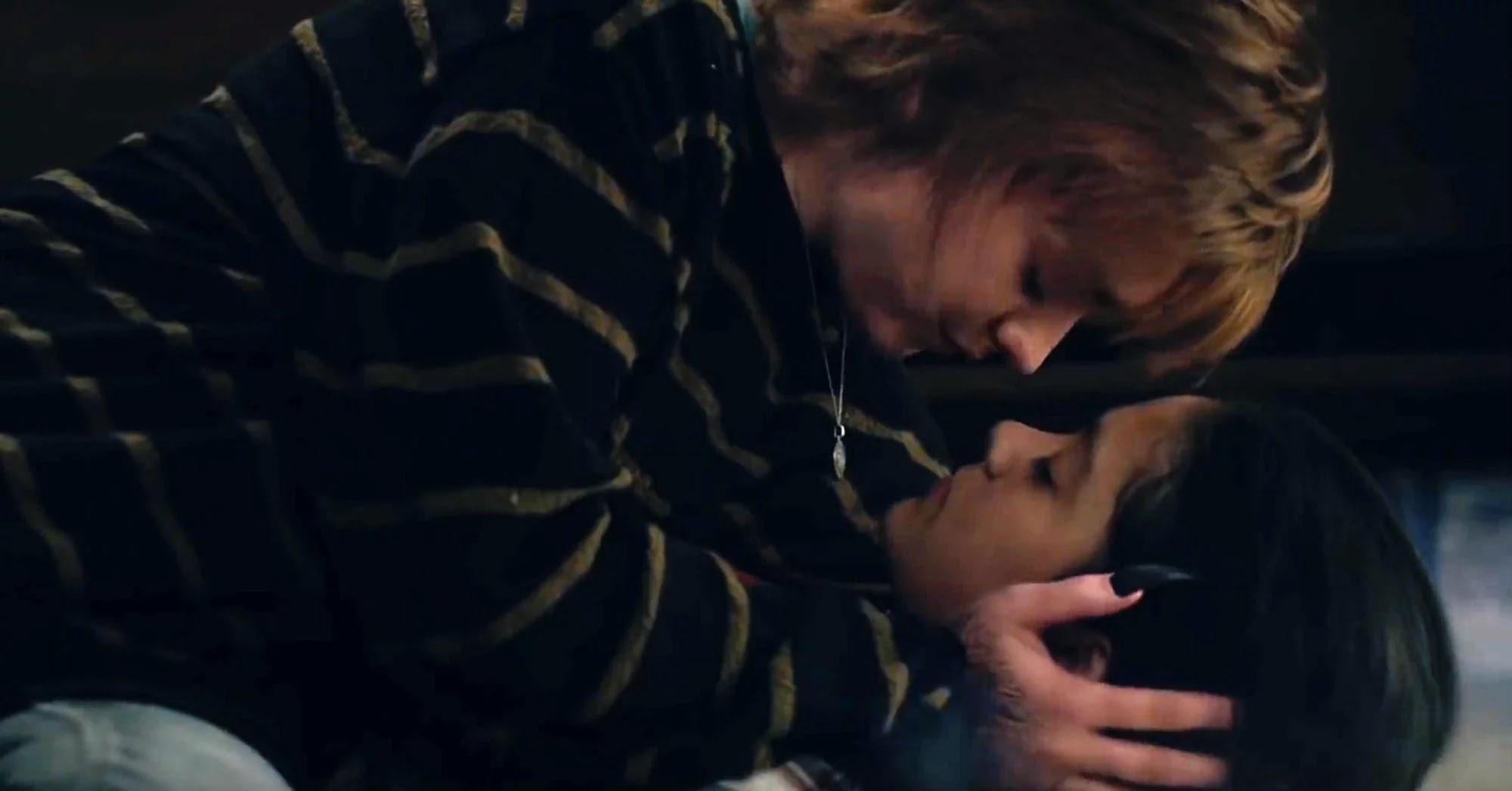
In the background of two scenes, we can see the youths watching episodes of Buffy The Vampire Slayer. Apparently the only entertainment afforded to the facilities patients. This inclusion echoes back to the comic book mutants relationship to television (then it was 'Cowboy vs Indian' Westerns distressing Dani, and Magnum P.I. enamoring Roberto). You can also feel the inspiration of Buffy throughout, but this is not only a nod to a preceding, influential text. It serves a narrative purpose, giving Rahne exposure to one of popular cultures most recognized and resonant lesbian relationships. Rahne's sexuality becomes entwined with the abuse she faced from the fundamentalist Reverend Craig, who dealt upon her lasting physical abuse and called the emergence of her mutancy-qua-deviant sexuality that of a witch. Her struggle is then one between the side of her that feels free and the side that feels shame. The re-emergence of Rahne's traumatic upbringing, as Dani's nightmare powers bring the ghost of Rahne's abuser back to brand her as a witch once more, doesn't actually factor into this, however. Rahne is just as happy to explore her newfound relationship with Dani. So whilst Dani's powers, throughout this film, perform a literal return of the repressed, it is only Dani and Illyana who face their returned fears head on, fighting to once more repress their nightmares. The rest of the patients are quite content to allow Dani to vanquish her own fears and perform their repression for them.
Dani and Rahne's relationship as seen in the film.
Where 2019's X-Men: Dark Phoenix is a not-so-subtle depiction of the dangers of surplus repression and the necessity of dealing with your trauma, New Mutants follows this legacy, albeit never in such a clear cut manner. Whilst it is the dominant theme throughout the film, the re-imagining of one character particularly dives into this question of repression and living with trauma. Many criticisms have been levied at a sequence of scenes having Illyana Rasputin, perhaps the closest this film has to a conventional action movie protagonist, espouse prejudice against the Native American lead. To many fans, transforming this character into what appears to be a racist bully is the far greater adaptational sin than the whitewashing of other characters. In my view, these criticisms come across as commentators either not fully engaging with the text or expecting these characters to adhere to some traditional superhero morality: something the film simply is not interested in. The comments that Illyana makes, being dismissive of Dani's Native American identity, bringing up crude, childish stereotypes and especially referring to Dani as 'Pocahontas', a preferred insult of not the most mature man in the world, are not simply to characterize her as a dominant, mean girl, but instead are part of this wider thematic exploration of repressed trauma.
Vital here is that Dani herself recognizes and calls out these insults and attempts at dominance for what they are. She specifically mentions that she heard them as a schoolgirl. It is a turning point in the film for Illyana, the deliverer of these petty, racial insults, who is then subsequently shown to be an eternal child; trapped in her traumatic past and incapable of moving forwards. Her coping methods are an abrasive personality and a puppet dragon named Lockheed, who doubles up as an imaginary friend. It is not to say that the cycle of abuse will inevitably turn us into racists, but illuminates instead the film's view of racism; that prejudice such as this is petty, childish, and a flaw in someone's individualized personality, rather than relating to any kind of structural oppression.
Recounting her story, Illyana talks about the abuse she suffered as a child, under what she refers to as the Smiling Men. She would later kill these men, 'one by one'. During the abuse, however, the child would recede into an imaginary world called Limbo- a 'special place' where the Smiling Men could not harm her. In concert with her mutant abilities, this place became real. No longer merely receding to Limbo, she would physically go there and can do so at will. Dani's power to return the repressed has a distinctly opposite effect to Illyana's own power. Where Illyana's 'special place' is made real, what Dani makes real are Illyana's nightmares; the abuse she created Limbo to escape from. As Dani receives a story-line about making peace with her repressed fears, Illyana too finds her source of power from repression itself. Both characters have engaged with their nightmares and resolved to once more push them out of view. The fight that ensues is then one against a child's horrific imaginings of her abusers. Disappearing into her Limbo world once more, Illyana will soon triumphantly emerge, empowered with sword in hand and an actual, realized dragon replacing her puppet. She slays these monstrous imaginings, going on to fight alongside Dani against the manifestation of her own repressed fear: the demon bear.
Their earlier clash, the scene that sparked such controversy, when seen in full and taken in the context of the film is in fact an important connection between the two. A relationship that may not adhere to conventional morality, but nevertheless is mutually beneficial. In true coming-of-age story fashion, their very exposure to new identities better equip them for the trials ahead. For that reason, I can't get behind the outrage at the mere depiction of bigotry. Certainly, it seems strange to watch a film that purports to have horror elements and influences, to only shirk away when the film dares to make you feel uncomfortable.
Importantly, there is a far more egregious instance of Dani's indigenous portrayal, that the proverb oft referred to in the film has more Christian roots than Native American, which demonstrates that Native American identity was poorly researched in the writing of the script. Manifesting on screen in a less than satisfactory way, the identity is nevertheless present and the portrayal of bigotry is not gratuitous, but informative. This is a sticking point, because I would argue that the depiction of Illyana's bigotry is simply not rooted in the same kind of racism that the casting of Reyes and Roberto was. I think it is crass to make such a comparison. If we are to be clear, I don't think this movie is blanket racist so much as it is specifically anti-black in its racism. There is a view, it seems, that the very presence of blackness will impede or supersede the story being told. Because, of course, there are no black stories to be told about trauma, repression or disciplinary institutions.
The New Mutants look to a future that will never come.
In this film, the New Mutants franchise has been re-imagined through the lens of post-racialism; where casting is colorblind, prejudice is a personal character flaw and indigenous belief systems are fictional sources to be adapted as if they were a comic book. The wider X-Men franchise has also been re-imagined to not only explore repression, but to highlight the roles that speciously beneficial disciplinary institutions, like schools and hospitals, play in said repression. But by never diving fully into its horror influences, it gives us a flaccid ending, wherein which the nightmares pull back, our characters neatly repress their fears once more and promptly walk off into a new day.
Spoilers may follow. Not that there are any that matter.
Ant-Man and the Wasp, sequel to 2015's not too bad Ant-Man and the 20th entry in Marvel's not too bad cinematic universe, is not too bad. It's an unfocused romp that never really earns its status as a big-screen entry to the Marvel story-world, often feeling like a spruced up one-shot, but still manages to glide by thanks to some great performances and the undeniable joy of the core gimmick. Shrinking and unshrinking people and miscellaneous objects remains as fun as ever.
Yet, 20 films, and 10 years, into one ongoing story-world demands something more than a harmless, safe, Summer blockbuster. At this point, the Marvel Cinematic Universe, with every new entry, must justify its existence. Ant-Man and the Wasp's greatest offence, then, is its sheer mundanity. There are two different types of boredom to discuss when it comes to this film. The first derives from how the film does nothing new or particularly interesting, allowing only its post-credit scene to contribute to any form of over-arching narrative. The second derives simply from how the film's pacing often screeches to painful halts, never knowing which parts of the film we want to spend more time with and which parts we'd have rather seen skipped over completely. The two moments which best exemplify this are when the opening tells us, bluntly, the film's mission (to return the original Wasp from the Quantum Realm) and, later on in the film, when Ghost, the villain of the place, tells us of her tragic (Eh) origin. I use the word "tell" pointedly. This is all too often a film about telling, not showing, and overdrawn narration on top of flashback sequences haemorrhages any flow and rhythm the film might have had. The second instance at least has a moment of subversion, interrupting the villainous monologuing with a video call between Ant-Man and his daughter, but it only comes after the expository function has been completed. It's a good gag, reliant totally on the perfect chemistry between Paul Rudd and his on-screen daughter (Make Cassie Lang an Avenger, you cowards), but ultimately, it's safe. It never threatens to undermine the character the screenwriter's are so committed to landing. Naturally, they failed.
The first instance had no such subversive moment, leaving an opening completely devoid of entertainment. It is, almost certainly, the worst opening to any MCU movie, and really sets the movie off on poor footing. It's a rocky, uneven road in the movie ahead, anyway. Each of the scenes feel individually conceived, creating a disparate film that seems only motivated to move from one gag to the next. Transitions between scenes are so clear and visible that it's jarring, with cliche name drops that lead directly to the scene concerning that name.
As I said previously, the film's greatest sin is its mundanity. Yet, it clearly didn't have to be this way. Ant-Man is Marvel's most exciting, yet least realised, franchise. It offers a unique opportunity to deal with intimate world-building, exploring clear themes of family and offering up development of the story-worlds past; the CGI technology that de-ages older actors for flashback scenes is pitch-perfect here, yet never used in as pivotal a way as we have seen elsewhere (Tony Stark in Civil War comes to mind). Even in the film itself, you can piece together what seems to be thematic links and an emotional core. Familial relationships are at the forefront, combined and utilised in different ways. You have two generations of Ant-Man and the Wasp, forming an impromptu family unit, facing off Ghost and her father figure in Bill Foster, and, off to the side, you have the extended family of Ant-Man's daughter, her mother and her mother's husband. Yet nothing meaningful or memorable is ever done with these parts. Rather than converging into the film's thematic heart, they are left carelessly at the wayside. It is a film which squanders its potential, limits its scope and makes you wonder why this had to be a feature-film at all.
The other missed opportunity is the Wasp, particularly the Evangeline Lilly/Hope van Dyne version of Wasp, who never earns her title credit. She falls into this new trend of female superhero who, having won the battle to be featured as a non-derivative, desexualised franchise-helming character, is never allowed the functional traits of the archetypal hero. When Hank Pym offers to dive after Hope's mother, in her stead, his robbery of her moment of self-sacrifice reminded me of how Wonder Woman similarly gave its big moment of heroism to Chris Pine's character. If self-sacrifice is a key tenet of developing and characterising the hero, then we can see that women are now allowed to be superheroes, just not the hero. Aside from that though, the realisation of Hope as a superhero in her own right seems to have taken from her a character arc. She had one in the first film, alongside her purely civilian/romantic interest capacity, yet here character development has been replaced by superhero iconography. The relationships of the film likewise take a hit. The very nature of the broader MCU sabotages its own individual components, with this film dealing with ramifications from the third Captain America film and the deterioration of relationships that has happened in the downtime between films. Going from the first Ant-Man to this one would not merely be a jarring experience, it would be untenable. Characters who were on positive terms with each other previously now have to navigate retreads of character tension. Is there a triumphant feeling when Scott and Hope come together, through adversity? No! Because the adversity has popped up out of nowhere, in some kind of sick rerun of the character tension from the first film.
All my criticisms aside though, this film has a great Morrissey gag. No, really. From The Cure in the first film, to the Moz in this one, it would appear that director Peyton Reid has a great taste in music. Perhaps he should give Ant-Man 3 a miss and just make some Spotify playlists. It is the comedy and lightness that makes this film enjoyable, despite its shortcomings. Visual gags abound and almost enough Ant-Man family sweetness really does the heavy-lifting for the film. It has to be understood though, that this cinematic universe rests on the precipice: it is all but guaranteed to survive until the Avengers: Infinity War sequel, but after that will the long-promised superhero fatigue finally kick in? I'd argue that, with more films as safe, trite and unimpressive as this one, it could be right around the corner.
Here we go again. In Marvel's current Wolverine-focused event, Hunt For Wolverine, writer Jim Zub is promising to put X-Men franchise mainstay Psylocke through another round of her perennial body swapping ordeal. From a leaked variant cover to #4 of the Hunt for Wolverine: Mystery in Madripoor mini-series and Zub's own confirmation, fan communities and comics journalists have discovered this plot point some weeks before the reveal. Before we delve into the torrid discussion surrounding the politics of body swapping (particularly in the case of Psylocke), let's first recap some history.
Psylocke, the telepathic, telekinetic mutant with a proclivity towards focused totalities and leather thongs, has had a series of debuts. Her first appearance, from creators Chris Claremont and Herb Trimpe, was in 1976 in Marvel UK's Captain Britain #8. Long before she was identified as a mutant, Psylocke was Elizabeth Braddock, twin sister of Brian Braddock aka Captain Britain. Her US debut was not until 1986, in New Mutants Annual #2, and her debut as Psylocke was in Uncanny X-Men #213. Already, we can see that the character has a more complex history than most iconic superheroes, whose debut most often occurs in only one comic book. But, it only twists more from there, as we reach the crux.
What is the most common visage of Psylocke? I'd wager it is this figure, from the 90s, the hyper-sexualised Asian body.
Yet, the Psylocke who debuted in Captain Britain, and was later seen in Uncanny X-Men, was not Asian. Not just that the character, as sister to Captain Britain himself, hailed from Britain, but that the character was Caucasian. A mild-mannered, upper-class styling of femininity, that belied a hidden strength, comic book creator Alan Davis once compared her to Thunderbirds' Lady Penelope.
So, what exactly happened? As with all things concerning the continuity of superheroes, it's complicated. Put simply, Psylocke, upon anticipating tragedy would befall the X-Men, entered through a magical MacGuffin that transported her to Japan and rendered her amnesiac. A dastardly villain sees this as a chance to groom a new master assassin for his nefarious purposes. Psylocke is brainwashed and is then, due to an incapability to abide outsiders, subjected to bodily transformation. She comes into conflict with some X-Men, she overcomes her conditioning, defeats the villain and gets the happy ending. Only there's no such happy ending, considering her body is no longer her own, but that of a Japanese ninja. This new iteration of the character is confrontationally sexual, alluringly deadly and suddenly an expert of Eastern martial arts. Psylocke is dead; long live Psylocke.
There was also a later incident of retroactive continuity that posited that there was another character who Psylocke had simply transferred minds with. This is a complete logical mess and beyond the scope of this particular piece. Even if I had the space for it, I wouldn't want to delve into that matter because, quite frankly, it makes my brain hurt. Regardless, this transition from British body to Japanese happened under the pen of the character's creator: Chris Claremont. With fairness to Claremont, the questionable ethics surrounding minds and body are a repeatedly explored topic in his X-Men comics (many of a similarly problematic nature, including turning two other White characters into Native Americans) and he would later return to this character and revise the transformation into an Asian woman, returning her to her British body. After a brief period of disuse (she had been killed, but silly things like that don't tend to stick), Psylocke returned in her original body in Uncanny X-Men #455.
For some time it seemed like the British Psylocke was to be a victim of "hypertime", a term borrowed from Grant Morrison's conceptualisation of a DC meta-universe, where canonicity is determined by a readership's almost-democratic decision and doesn't adhere to what is strictly in texts. Whilst Psylocke had returned to her British identity, comic book artists simply refused to stop drawing her as the hyper-sexual Japanese ninja. After spending some time in flux, (textually white, yet aesthetically Asian) Psylocke would experience yet another body swap (courtesy of Matt Fraction) in Uncanny X-Men #508-511, this time reconciling artist measure and definitively situating Psylocke in the Japanese body. So definitively, in fact, that over the course of this story Psylocke's original body was mutilated and destroyed; a bizarre realisation of the idiom, "you can't go home again".
There are actually few enough differences between the renderings of the two ethnicities that you could get away with saying that Psylocke had always been, in some part, Asian. It would not be the most ridiculous moment of retroactive continuity in X-Men franchisehistory. Certainly, this is one solution posed by those who see both the problematic nature of the character's Asian body and the value of such a popular Asian character. Yet what is abundantly clear is that the moments of sexuality diverge with the change of ethnicity; the Japanese woman is afforded a fetishisation and sexualisation that the White, British woman simply never is. What's even more interesting here is that Psylocke did not merely go through the body swap and come out on the other side a newly sexualised character; she was always objectified, her modelling career backstory serving as an opportunity for male creatives to curate her for male audience consumption. What we then see are two distinct sexualities and femininities- both curated for male consumption, yet disseminated in separate ways.
I think it's fair to say that the femininity associated with the British Psylocke is privileged in the readership's eye. Her objectification can be considered a higher, more sophisticated cultural process than the comparatively crass and base depictions of Japanese Psylocke. You can see this in the distinct costumes the different realisations wear, but also in how the body is posed by artists. The Japanese body is almost always contorted in some unnatural way so as to always deliver some element of sexuality. The White body, meanwhile, is allowed some dignity in its objectification. Whilst still a conservative realisation of beauty standards, the White body is at least allowed to look human.
It is also worth noting that, alongside the new body, Psylocke gained new traits and abilities that had never been realised in her British form- particularly ninjutsu and an affection for all things Japanese, or, at least, all things Japanese by way of America. This is a woman who had been raised in a privileged, upper-class British household, with no feasible connections to the culture she had now become endowed with. The Japanese Psylocke had, for the swathe of the character's popularity, become the preferred reading. It is this version of Psylocke which is realised in cartoon adaptations and even in Olivia Munn's portrayal of the character in X-Men: Apocalypse. Her dated costume was criticised widely, but, to fans of the comic book, this was merely an apt adaptation of the source material. So the Psylocke of the wider consciousness is this crass, dated character of a Japanese superhero, yet therein lies the inherent danger of further meddling with her identity. She is known to be a significant Asian character and to obliterate her is a serious mark against a brand that focuses itself around sympathy towards identity diversity, if not identity diversity itself.
To question Marvel's fetishisation of the East is vital, considering the context of the recent promotion of Akira Yoshida (the alter-ego of white comic book creative C.B. Cebulski) to Editor-In-Chief; white people using Asian identities to promote themselves isn't just a textual phenomenon but a metatextual one also. What, then, does this return to Britishness and whiteness signify? Is it an attempt to remove the criticisms of authorial orientalism, or, perhaps, audience orientalism? Does Jim Zub seek to absolve Marvel of these issues or to simply allow fan communities to overcome this point of contention? After all, the constant re-switching and renegotiation can be attributed to a synoptic fan community, where the many (an audience devoted to multiple realisations of genre and character) interact with the few (the creatives actually involved with the generation of new stories) and all each proclaim themselves as arbiters of true representation. To me, though, I think there is something more profound and zeitgeistic at hand. Despite the surface-level diversification, wherein which a Caucasian character is replaced by an Asian one, we can read the Japanese Psylocke as actually endemic of the homogenising force of the 90s- the superhero comic book's "Dark Age". Where Psylocke had previously been allowed to exist as her own unique entity, complementing the make-up of the X-Men franchise in her own way, the onset of the 90s came with a clear, decisive mission.Everything has to be cool. Everything has to be dark. Everything has to be big. And everything has to be sexy. This new return to Psylocke's original body feels like a condemnation of the "Dark Age" design ethos, in a context where superhero audiences beyond the straight, adolescent male are finally being considered. By abolishing the Asian body, Jim Zub may also be abolishing the dehumanising sexuality associated with that body. Rather than to reconcile the inhuman, orientalist subject with dignity, the subject is to be replaced by the White: dignity present by default.
Then we are finally faced with the impossible question. To return Psylocke to Whiteness is to obliterate one of the franchise's most significant Asian representations, whereas to persist with the Japanese body is to likewise persist with the American fetishisation of Asian identities. With any new property or adaptation, it's an easy decision to just meld these characters together. Reproduce Psylocke as an Anglo-Asian character, from birth, and you side-step a lot of the concerns at hand. This does not, and can not, hold up in the ongoing, serial format of contemporary comic books. The format would resist it, fans of the format would resist it, and soon enough you would see a return to the status quo, proving any noble work done to progress the character moot. Only time will tell if Mystery in Madripoor can finally quell Psylocke's existential questioning for good, but, whatever the answer to this conundrum is, I think that it is clear that it cannot be found in the constant switching, re-switching and re-re-switching of bodies.
In a way, the answer means little. Such a fraught cultural issue benefits more from the question. The fictional Psylocke is no ubiquitous battleground for debates around orientalism in contemporary popular culture, but, rather, is a microcosm from which we can further scrutinise issues of representation at large.
An in-depth re-examination of "Duel." Uncanny X-Men #201. Chris Claremont (W) and Rick Leonardi (A). 1986.
One of the 80s X-Men's most pivotal issues, "Duel" is one of several watershed moments in the transition from Claremont's first iteration of X-Men into the hardline, rebellious group that would populate the "Outback Era". The eponymous "Duel" refers to a match between a de-powered Storm and new father Cyclops (aka Scott Summers), competing for the leadership of the X-Men. Storm's victory would set the X-Men on a new, era-defining path, which lends the issue itself to be read as a Storm-centric, 'feat' issue. I want to offer up an alternative reading, as this issue isn't actually about Storm at all. Rather it comments, primarily, on two things: Cyclops' character and the unescapable, cyclical nature of superhero genre comic-books.
Despite being a cover star, Storm, in this story, is not her own champion. She isn't really overcoming the masculine incumbent to finally probe herself worthy, as she already has the support of the team (Logan, particularly) and faces no significant obstacle to overcome. Her journey towards leadership, her exam, was the preceding issues. "Duel" is more so her graduation, where she is formally recognised for her previous success, and her ascendance to leadership has a real essence of inevitability. The story then becomes not a story of "Who will lead them?" but how can Cyclops cope with the realisation that he has become obsolete. Storm, instead of operating as her own champion, is the champion for Madelyne Pryor- Cyclops' scorned wife and mother of his child- and, further, a representation of the X-Men's (both team and franchise) ability to survive without Cyclops. Storm is the Claremont-driven future, confronting Cyclops, one of the final handovers from the Lee/Kirby original conception. Cyclops has proven inattentive to his wife and newborn son and Madelyne, as civilian, cannot challenge Cyclops' absence in the way that superheroic Storm can. Storm steps up as a defender of the innocent, because she has gone through her own journey to do so, but this is not a significant action for her character.
Tension comes from all sides, as Storm has been making herself a viable presence, despite her loss of powers, in the preceding issues, and Cyclops' peaceful retirement has been interrupted by repeated super-heroics. Not only does the return of Cyclops create tension for his civilian wife, but with the stories own writer as well. Chris Claremont's plotting here reeks of frustration; editorial mandate ensured that he could not effectively retire Cyclops from the X-Men, as per his original intent and, with the launch of Cyclops-starring X-Factor, logical development for Cyclops' character was jettisoned in favour for a return to the status quo. The problem posed for Cyclops in "Duel" is that he has never learned how to relate to the X-Men outside of a micro-managing, obsessive leadership role, his single eye representing his singular vision for how the X-Men can reach their goals. When this issue challenges that, it should have been a moment of reflection and change, one which the character could grow from. Yet what we saw instead was the instantaneous return of the character to a leadership role; one that would remain mostly unchallenged for twenty-five years. The tone is never sympathetic to Storm, her victory is sombre and focused entirely on her opponent, and I'd argue that this is because Claremont never meant it to read as a cheer-able moment. Storm's silence allows Scott's mind-space and we are given a final opportunity to read Cyclops as the issue's tragic main character.
The Cyclops we see in "Duel" may be a sad figure, but he's not an unsympathetic one. If there is a main character here, it is him. Rather than documenting Storm's thunderous triumph, Claremont walks us through Cyclops' total defeat. And it is a defeat. Retroactive continuity, attempting to make the character a more clear-cut superhero again, transformed his loss in "Duel" to be a product of psychic interference on behalf of Madelyne (who was also retroactively transformed into an unknowing clone of Jean Grey), but even the original shows that he loses because of her. Only, in the original, his defeat comes from distraction, confusion and self-loathing. Cyclops defeat of himself is more prevalent than Madelyne's psychic interference or Storm's competence ever could be. That isn't to detract from Storm's ascension to leadership but, as mentioned previously, she earned that well before this issue took place. This particular story documents not an even match, but a loss.
So, I do think that we are supposed to sympathise with Cyclops in this issue, only we cannot do so from rigid moral perspectives. His conflict is reprehensible, he is prioritising his own identity anxieties over the welfare of his infant son, yet he remains still relatable. He acts selfishly, not inhumanly, and, whilst on the surface level the character can come across as a deadbeat dad, that is not wherein the tragedy lies. Rather the tragedy comes from Claremont's criticism of the cyclical, repetitive superhero comic book, the book which always returns to the status quo.
Storm's victory is telegraphed early on in the issue- she wins by removing his visor, leaving him incapable of controlling his powers, and earlier on we see Cyclops requires focus to manage his visor; a focus he did not have because of his conflicting feelings about Madelyne, his baby and the X-Men. The use of the superhero icon of the costume reiterates thematic qualities in the story, such as Cyclops' inability to comprehend a life outside the X-Men; not once does he remove it in this story. Even when arguing with Madelyne, all he can do is pull back his hood. Even in domestic affairs, Scott Summers can never truly detach himself from his X-Men identity.
And it is here that the tragic reality of Cyclops is exposed. The Cyclops we see here is somewhat of a nowhere man- he has graduated into civilian life, yet, because of the nature of the medium, he finds himself incapable of leaving the X-Men. He can dream of a normal life, but he must also destroy it, lest he truly find happiness and remove himself from the superhero genre altogether.
We see a theme of parenthood and legacy prevalent in this issue, interrogated not only through Cyclops, but Xavier also (Rachel Summers feeds into this theme, also). Cyclops is derided for his lack of commitment to his family, his son particularly, yet his father figure has also recently abandoned him. Claremont makes a point of reminding the audience this, so we can read the Cyclops of "Duel" as a product of Xavier's questionable parenting. Cyclops has never been able to define himself outside of the team, becoming institutionalised, and Maddie herself calls Cyclops out for having no skills to support a family. In his Astonishing X-Men run, Joss Whedon also touches on one of the recurring traits of Cyclops as a character- outside of leading the X-Men, Cyclops has nothing else. As an orphan, groomed and educated for a single purpose by Charles Xavier, Cyclops is totally lost when the structures and rules of his world start to fall apart. Feelings of trepidation in the face of giant monsters or battles in space pale in comparison to his feelings of abandonment.
He had dedicated his life to the X-Men, who now no longer need him the way they once did, and absent father Xavier has no advice to give to Cyclops at this moment. I read this as a demonstration that the key conflict of "Duel" is, not between two superheroes, but between two families- namely Scott's X-Men family and his family with Madelyne.
Claremont has Cyclops act as unwitting commentary on the failings of attempting to tell exciting, emergent stories in a medium and genre that relies on tedious, nostalgic revisiting. Cyclops' refusal to grow up and learn to define himself outside of the X-Men, his core emotional conflict of the issue, reads as commentary on a format that itself refuses to grow up and define itself outside of the trite framework it has found itself embroiled in. Claremont takes an artefact of the medium which he has no control over, the inevitable return of Cyclops to the X-Men, and crafts it in such a way that is has emotional relevance, narrative meaning and contributes to a greater understanding of the character. Before #201, you could see that Cyclops had less of a life outside of the X-Men than his counter-parts, but this is the issue that solidified a Cyclops who didn't know how to exist outside of leading a team. It would define characterisations of Cyclops for decades to come.
I do not feel that "Duel" can be read as a Storm-centric issue, because it just isn't one. It does the story itself so little justice to be relegated to a footnote on a 'Who Could Beat Storm In A Fight?' piece. The issue also shouldn't be used as evidence for some imagined Claremont hatred for Cyclops, for it truly shows Cyclops at his most complex and, in a meta sense, profound. Cyclops is used as a narrative tool to examine the genre and franchise- signifying the forthcoming era change, whilst also reflecting back on the mind-set that insists on constantly bringing him back.
"Duel" is about a Cyclops loss. In fact, it is about many Cyclops losses. This is arguably the character's lowest point, but Claremont's final deconstruction of the character is one of his most meaningful and significant issues for Cyclops characterisation. More than just being about Cyclops though, the issue is apt criticism of the failings of the format itself. It is telling that Claremont's first tenure on the book ended with Cyclops restored to his leadership role, with marriage to Madelyne dissolved and no baby son to look after. The status quo, and sanctity of the genre, will persist, no matter which character stands in the way.
It is worth noting that Claremont utilises Storm specifically to remove Cyclops from the franchise's flagship book, despite having, at one point, intended to push these characters into a relationship together. Such a couple is now unimaginable and, arguably, our incapacity to imagine such a relationship derives from misreading this very issue. The perception that it is Cyclops who stands as a barrier to Storm's leadership and independence has formulated an undeniable antagonism between the two, one which has persisted in how these two have been characterised through Cyclops' (most recent) death. This may also go some way to explain the frothing, vitriolic hatred that dedicated Storm fans and dedicated Cyclops fans seem to have for each other.
The torrid relationship between X-Men franchise mainstays Kitty Pryde and Colossus, promises to reach its climax in this Summer's "Wedding of the Century". Thus Marvel responds to DC's marriage of their forefront franchise icons, Batman and Catwoman; and even as a franchise devotee, this is underwhelming. Partially because of character status, as Colossus and Kitty Pryde are not as culturally ingrained as the Bat-Family of comic books have been, but also because of a cold, dispassionate drive towards this much hyped marriage. What we are seeing with the wedding is a microcosm of not merely the X-Men: Gold series' wider problems, but of Marvel Comics' as well; with initiatives such as ResurreXion, Legacy and Fresh Start, stagnation is being sold either as progress, or in place of it.
The Most Beloved Marvel Weddings! *Not Pictured: Kitty Pryde and Colossus.
X-Men: Gold, launched by Marc Guggenheim and Ardian Syaf last year, has promised to push the franchise in new directions, whilst looking back and staying true to its identity; with Guggenheim stating, "...our mission statement for the book, which is going backwards to go forward.". It's a nice sentiment, but upon reading the book, you realise that sentiment is all that it is. This isn't of particular news, the comic book format itself demands this kind of nostalgic, cyclical storytelling, but what we can see when reading Gold is that nostalgic revisitations of status quo don't only have narrative implications, but ideological ones also. That Marc Guggenheim has written this story by looking back on the franchise's history, uncritically, he has represented an inherently flawed relationship with a white-washing perspective.
Gold has taken rebuilding the Colossus/Kitty Pryde relationship as one of its primary concerns; our last sight of these characters had them as far away from each other as they had ever been. Kitty was in fact engaged to another Peter (Peter Quill, of the Guardians of the Galaxy) and Colossus was engaging in an exciting relationship with Deadpool 2's breakout character Domino. Kitty was in space during the last flagship X-Book and Colossus was possessed by a future-timeline-Apocalypse (it really is best not to ask). The line preceding the launch of Gold (part of the ResurreXion initiative, which relaunched nearly all ongoing X-Books) is widely considered one of the worst times to have been a fan of the franchise, as the build-up to the Inhumans Vs X-Men crossover event was mired with the jettisoning, mischaracterisation and killing of fan-favourite characters. The tone was one of hopelessness, so Gold and ResurreXion aimed to move away from this status quo as swiftly as possible. Kitty Pryde, and her nostalgic return to her relationship with Colossus, is emblematic of a wider shift back to a safer, more audience-friendly status quo.
The concern with the return is that it has not been a mere revisitation of stories and characters gone by, but it is a rerun of a relationship that was a categoricfailure. The heart-rending break-ups and the extremely violent jealousy are mere prelude to the crux of the relationship, first laid out by writer Chris Claremont; the age gap between these two young people. Whilst ages in comic books are rarely specific, we know one thing for certain- Kitty Pryde was underage when she and Colossus first pursued a relationship. Writers following up on the relationship miss out on why the relationship needed to end messily; not only was it two hormonal, young people ill-equipped to navigate interpersonal relationships but there is a pretty clear ethical concern in depicting the flawed, complicated, morally-questionable entanglement of these characters as a generic love story. Writers such as Guggenheim re-characterise incidents with questionable power dynamics (most notably, "Merry Christmas Sexy" from Uncanny X-Men #143) as part of a retroactive, overarching love story by revisiting them. The first iteration of their relationship is innocent enough, it is a 13 year-old with a crush on an 18 year-old who doesn't quite understand how to deal with the situation. It's cute watching a hyper-masculine superhero blush. It's less cute when they are 14 years-old and 19 years-old and a decision is made to see the relationship to more serious stages. The quite predatory nature is not merely looked over, but incidents where it is made apparent are romanticised.
And these problematic, nostalgic returns are seen across the board with Marvel's white-washing brand initiatives. Sam Wilson's Captain America has been cut out in favour of the original in Legacy, with the 14 year-old black MiT student IronHeart pushed away for the original Iron Man and Jane Foster's Thor giving away to Thor Odinson in the lead-up to Fresh Start. Diversity may not be being pushed entirely out of Marvel's books, but it is being again relegated to side-stories and more obscure parts of the Marvel Universe. Gone are the days of non-white, male lead flagship titles.
Yes, it really does matter.
Guggenheim is not the first to revisit the relationship, nor the first to revisit it with a white-washing perspective. Much of the complaints that can be levied towards Gold's interpretation of the relationship can also be levied at Joss Whedon's popular run on Astonishing X-Men, which also brought back the relationship, with an uncritical lens, amidst a plethora of character baggage. Whedon, however, was working through a particularly different context. The status of the Kitty/Colossus relationship before Guggenheim was definitive, they were broken up and it had ended badly. Whilst they reconciled as friends, writers such as Jason Aaron and Brian Michael Bendis had made clear that a relationship between the two would amount to nothing more than repetitive, unfortunate reruns. Arguably, they have yet to be proven wrong. Similarly, the couple were separated before Whedon's run, but with the caveat that Colossus was previously dead for several years (he got better) and Kitty had been in a state of disuse for almost as long as that. Whedon didn't need to naturally foster the re-relationship and any accusation of white-washing could be attributed to the elating effect of having a loved one return from the grave.
There are then many similarities in the conceptual approaches towards the franchise employed by Whedon and Guggenheim- both desired a return to an iconic, unfulfilled romance of their youth alongside the return of conventional superheroic tropes and icons (notably, the colourful costumes). In Gold though, this nostalgic storytelling is having a more dangerous effect than merely returning a superhero franchise to its glory days, the wedding has become a regressive narrative point. Guised in Guggenheim's performative, lightweight feminism, we have seen the Kitty Pryde approach to both leadership and the marriage.
Below we can see a recent problematic incident from X-Men: Gold #27. It may seem innocuous, but in Guggenheim's desperate attempt to show Kitty off as a strong, modern woman, he obliterates her Jewish heritage and identity. In Jewish weddings it is customary for both parents to accompany their child down the aisle, so this whole interaction is pointless, serving only to imbue Kitty's mother with some internalised sexism for her daughter to dispel.
Walking 15 feet? It's a man's job.
Guggenheim's unsatisfying strand of feminism (which has seen him declare that "reverse sexism isn't the answer") is actually impeding diverse stories, evidenced not only by the removal of Jewishness from the upcoming ceremony but from the fact that a character, so long associated with bisexuality, is being subjected to a hetero-wedding. As every year passes, and another writer adds another Peter to Kitty's romantic history, this important character detail is procedurally whittled away; I think very few people even acknowledge her as a bisexual character anymore, let alone one of the X-Men franchise's most prominent ones. So, in these reminiscent relaunch initiatives characters are not just removing the questionable character contexts of characters, but also removing deviant character identity, a potential plea to conservative audiences who no longer see themselves in works that increasingly represent the diverse, real world.
Yet, there is at least a surface-level refusal to fully capitulate to the alt-right commentators who want to see Captain America fight ISIS under the orders of President Donald Trump; evidenced by some enduring legacy characters and a commitment to telling stories with female characters at the forefront. It is these focal women who stir up further criticism though and, as we've discussed Guggenheim's lacklustre approach to feminist politics, the development of 'strong Marvel women' tropes may be impeding wider moves towards progressive storytelling.
Similar to her determination to score progressive points by making a show of having her mother escort her at the wedding, Kitty Pryde is shown to be the one proposing to Colossus. This is bold, determined and shows she's a character who takes her personal life into her own hands, unguided by anyone else. In fact, her proposal panel is widely recreated, constituting promotional imagery and the cover to #26. One, tiny gripe. Kitty didn't make this decision. Colossus brings it up, before their relationship has truly reformed, in #9. It is provided as the way to move their relationship forwards, despite neither character seeming to be learning or evolving from their past experiences. Here, we see one of the tropes to these new strong Marvel woman; they possess and present their own agency, after male approval.
Nothing gets the fires of romance stirring quite like the noise of construction work.
This is seen beyond Gold's wedding storyline, in characters such as the revamped Captain Marvel and notable SHIELD figure Maria Hill. Captain Marvel, who has existed previously as Ms Marvel, Binary and Warbird, has been redistributed as the strong, modern woman, by taking the suit, name and qualities of her male predecessor. In a more meta sense, Maria Hill's rise to Director of SHIELD was similarly based on male mentor figures and employing attributes of masculinity. Hill's directorship of SHIELD resembles Captain Marvel's directorship of Alpha Flight which resembles Kitty Pryde's premiership over the X-Men and, at the moments of their transformation into the modern Marvel woman, these three characters all conspicuously exhibit similar pixie cuts.
There is, of course, nothing explicitly offensive about the haircut. Yet, when it perennially appears for Marvel's "strong" women there is a sense that women can only achieve positions of power when taking on masculine qualities. Captain Marvel has been criticised for being depicted as increasingly less feminine, and whilst these comments arise from more lecherous readers who want Captain Marvel to exist primarily as a sex symbol, this criticism does shine a light on this emerging trope. Short-haired, unfeminine, white women in positions of authority are the main thrust of Marvel's 'wokeness', impeding diverse representation and limiting the narrative potential of its female characters. It's worth noting that the first character to take up the Captain Marvel mantle, after the original, was a black woman who is nowhere to be found in current publication.
A haircut doesn't constitute character progression. From Left to Right: Captain Marvel, Maria Hill and Kitty Pryde.
So, what we seem to have is Guggenheim relying on the trope of marriage for serial narratives. From comic books to soap operas, we see that works which resemble pulp fictions often revert to the same plot points when a shock or signal of development is needed. Murders, a secret affair or a wedding tend to be the most prolific, often with them all converging (perhaps on a Christmas special). The wedding here serves as a cheap way for Guggenheim to leave his mark on the franchise; people won't be able to hand-wave away his work on the franchise as easily as he did the work of those who preceded him. But with Marvel's need to capitalise on a big narrative moment such as this, the inevitable tie-in (X-Men: The Wedding Special) has actually allowed us to see other writers attempt to reconcile this troublesome pairing.
Chris Claremont, Marc Guggenheim and Kelly Thompson each wrote a story for the Wedding Special, but with Claremont and Thompson's stories we see a nuanced character focus that attempts to push Kitty's mind-space forwards- beyond the 'strong female' caricature Gold has portrayed her as. Thompson gives her some pre-commitment anxiety, with nods to her bisexuality, whilst Claremont gives her resolution with the deceased men of her life and a Doctorate. Rather than showing marriage as a prosaic marker of character and relationship progression, these writers utilise the wedding as a point from which to derive further, deeper character drama. Whilst mired by the circumstances surrounding it, the Wedding Special is genuinely enjoyable, with a solid emotional grounding. It is beyond the scope of this post to question why this intelligent writing has not been able to manifest within the main storyline itself, but it is interesting food for thought nonetheless.
Piotr evidently had this suit tailored specifically for his metal form. I just want to know why.
There is a lot of narrative potential to this coupling because of its flawed nature. Whilst this has been glossed over, the potential for the wedding is there. With the upcoming return of Wolverine, he has the perfect chance to make a creepy cameo appearance like when Cyclops and Jean Grey married, for example. More than that though, the virulent relationship could really bubble to the forefront. Confrontations could emerge, finally exposing Colossus for his shameful role in arguably grooming a 14 year-old girl or declaring that childhood crushes are inappropriate places to form long-lasting relationships. There could be conflict between Colossus' over-dominance and Kitty's newfound responsibilities, or the moral journey both have been through in recent years. The wedding itself has a unique opportunity to deconstruct one of Marvel Comic's most beloved yet troublesome relationships.
However, it seems most likely that the "Wedding of the Century" will be yet another point of stagnation for Marvel Comics. We are constantly promised a world that reflects our own, that lives and grows in the way our lives do, but that world remains hopelessly cyclical. Characters retread beats they had moved past, act without the context of their own histories and are forced to lose defining attributes of their identity. Perhaps it is a question of format. Perhaps the cycle can never truly be broken. If this is the case, studies of the comic book medium will have to acknowledge that no matter the counter-cultural influences on superhero storytelling, a conservative mindset is always waiting off-panel for its return.
For the wedding issue itself, there is clearly room for subversion. A bait-and-switch wedding could be the exact kind of twist Gold needs to shake-up its storytelling rut, but even if this becomes the case, the journey has been rife with such nostalgic storytelling that even a collapse of the couple could pave no new path for the franchise.