Spoilers follow.
New Mutants, in the immediate collective response to its release, has been plagued by one thing above all. Not the oft associated delays, but instead with the question of adaptation. Adaptation is a difficult topic to discuss. Personally, I find that adaptation is a futile lens through which to analyse a film. More often than not, we should look to the meaning of the film as its own text and take it on its own merits. However, especially in the superhero genre, adaptation is also a site which creates meaning. This is not only a film that has caused controversy with its adaptation of the source material, but also one whose meaning lies in this very adaptation.
First, to address the elephant in the room, the films adaptation of race is galling. Discussions surrounding whitewashing in this film are fair, accurate and necessary: Two characters, Dr. Cecilia Reyes and Roberto DaCosta, who are both traditionally depicted as black characters in the source material were portrayed by two decisively non-black actors: Alice Braga and Henry Zaga, respectively. The director, Josh Boone, attempted to address these questions of whitewashing, and chose to opt for the strange strategy of doubling-down on his colorblind casting approach. Boone has since deleted his Instagram account in response to the backlash.
In my view, what makes this whitewashing so necessary to acknowledge and engage with is not merely the erasure of black identities, but that it informs the wider lens from which the film was produced. When we look to Boone's comments, where he suggests that a non-black actor could better deliver a portrayal of a privileged upbringing, we can see that it is in fact little to no different to what presidential candidate Joe Biden has also said. I do not bring Biden up without reason- that their comments are similar matters because it informs us on the film's ideology. It is the post-racial view of the liberal who believes, with so much time removed from the Civil Rights Movement and the election of President Obama, that racial conflict and injustice is a thing of the past. Importantly, the director's post-racial lens seems to have influenced not only casting decisions, but the depiction of mutancy itself.
In New Mutants, mutancy is alternatively the condition or gift of superhuman powers. An offshoot of the X-Men franchise, where mutants are a deviant minority who are taught to use their powers at superhero school, the New Mutants shifts the locale from that school to a mental institution instead; focusing primarily on Dani Moonstar, a Native American mutant whose powers bring nightmares to life. Horror genre antics ensue. With regard to adaptation, as it is an adaptation of the New Mutants comic book series, it's worth looking at the film's own perspective on this. When we do so, I think we see that this the loosest of adaptations, one that prioritizes re-imagination and re-invention to create its meaning. Re-imagination, that is, of not just of the New Mutants characters and story, but of the X-Men franchise on the whole. If there is a compelling idea in this movie, it draws itself from this.
One such re-imagining is when we see the comic book Sam Guthrie, whose powers famously made him nigh invulnerable when blastin', inverted in the film- becoming a character who instead knows only hurt. An emotional hurt, sustained from childhood, but repeated, self-inflicted physical pain also. That invulnerability is stripped away as part of the character's journey from page to screen.

It is indicative of the re-imaginings on the whole. Where Sam is re-imagined as self-destructive, Roberto is re-imagined as an insecure boy fronting as a jock and Rahne Sinclair is re-imagined as a lesbian, facing conflict between her sexuality and fundamentalist Christian beliefs. One rumor that set social media and fan communities aflame was the notion of Storm being originally cast in this film as a jailer role. Whilst that never manifested, the design ethos is clear: gone are the trappings and moralism of traditional superhero fictions. These are not X-Men, mutants hated and feared by humans, but rather teenagers who hate and fear themselves.
The most significant of these imaginings, however, is both the thematic core of the film and something deeply alienating to the fan audience. Rather than take place in the iconic school for mutants most associated with the franchise, this film relocates its cast of characters to a mental institution. A jarring change, for sure, but one vital to the film's meaning. By moving the traditional X-Men coming-of-age story out of a school and into a mental institution, what we actually have is merely the exchange of disciplinary institutions. This change serves to highlight not the differences between the story of the New Mutants and the X-Men characters, but rather the similarities. They are repressed, traumatized individuals, sequestered away from the public, supposedly for their own good. The student is treated to the same institution as the patient or the prisoner; in this film, Dr. Reyes keeps her subjects all under constant, panoptic surveillance. It is a re-imagining of the school setting, a haunted hospital, an asylum and a prison all at once. That the film chooses to reveal that Reyes does not, in fact, work for the X-Men, perhaps helps the film go down easier with hardcore fans, but weakens the text as a whole.
Nevertheless, the school/hospital exists as a site of the return of the repressed, where deviant sexuality and identities inform the condition of mutancy. So far I have neglected to discuss the film's constant delays and unfortunate production cycle. Too easy would it be to fall into the trap of maligning the 'New' in the ever-delayed New Mutants. A witty critique, to appease the readers who look to a film review for a good pun and a reaffirmation of their own opinion. To do so would miss the mark of meaning: the title 'New Mutants' is a reference to two things. The first, Marvel's original name for the X-Men franchise 'The Merry Mutants', and herein we can make whatever joke we like about them not being so new anymore, but the second is all the more compelling and informative. 'New Mutants' was how literary critic Leslie Fielder, in 1965, referred to the new generation of Americans engaging in counter-cultural practice. He lambasted and feared the turn of the new generation from the values of the old, feared the perversion of conservative social norms and could not abide what he referred to as the 'irrationalists'.
The title New Mutants carries with it this weight, twisting it on its head, but retaining that particular association with a thematic generational conflict that has its roots in even the earliest of X-Men comics. Realized in this movie, the rebel youth have to break away from the authority of an older generation who can offer them nothing, but abandonment and abuse. Boone's mutancy no longer possesses a racial or genetic element, present in both source material and the film franchise at large. That this mutancy develops at puberty is highlighted, as is the sexual relationships between the youths. It is not to say that there is an inherent danger to sexuality, be it divergent or normative, but rather professes to explore the dangerous effects that surplus repression can have.
For the men, it is the manifestation of their failure to perform the masculine function. Whilst Roberto embodies a direct, physical emasculation, his powers causing him to become "Too hot" in sexual situations, leaving him unable to adequately perform, Sam's character imperils the social function: not only committing patricide, but collapsing his very source of labor and income also. He has killed his father, but cannot replace him. In both of these cases, the masculine role in the nuclear family model threatens to fall apart. The feminine role in that structure threatens to fall away also, as depicted in Dani and Rahne's relationship with subversive sexuality. It is a lot more pronounced and the relationship that forms between them is depicted quite clearly.
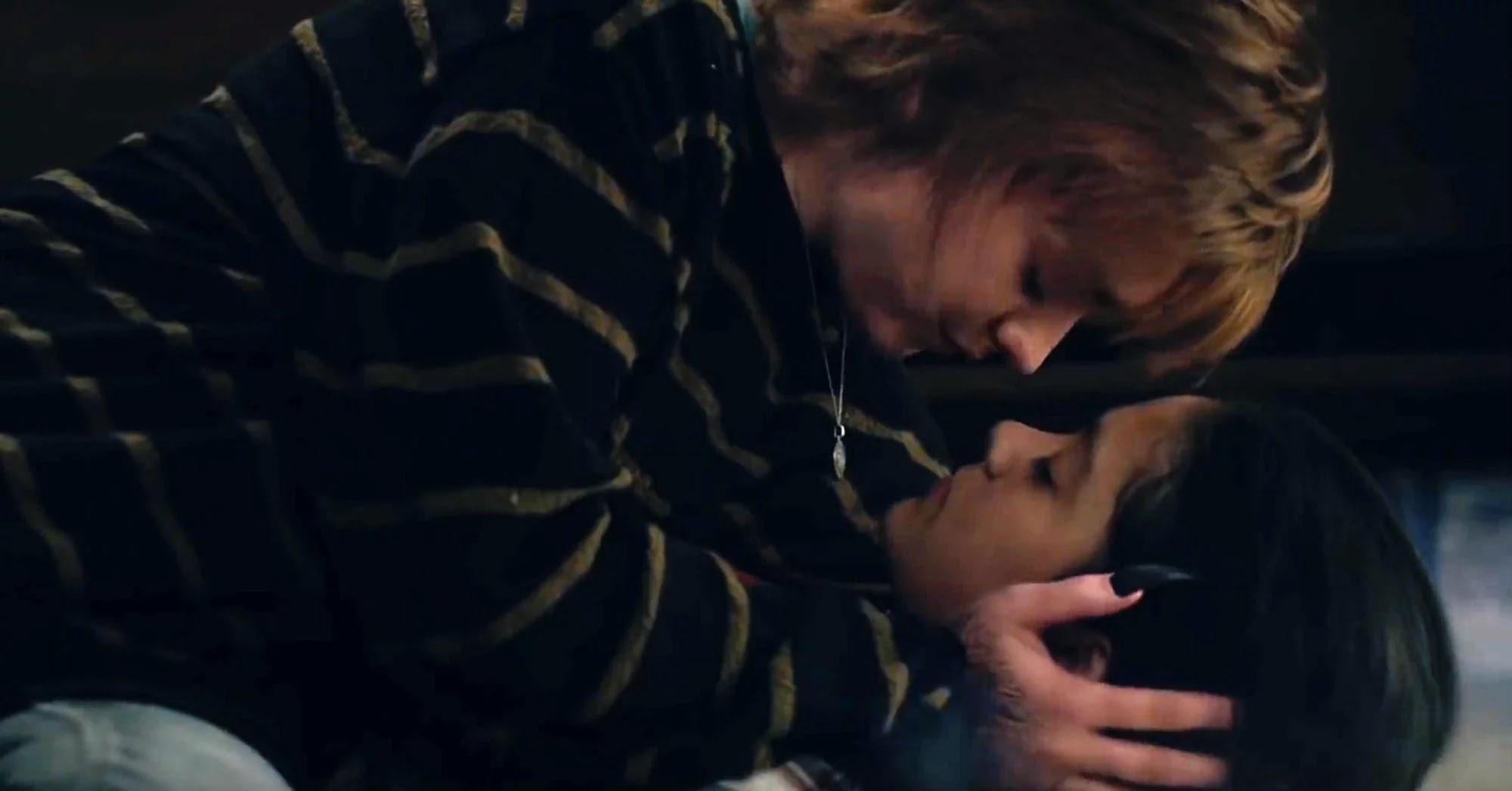
In the background of two scenes, we can see the youths watching episodes of Buffy The Vampire Slayer. Apparently the only entertainment afforded to the facilities patients. This inclusion echoes back to the comic book mutants relationship to television (then it was 'Cowboy vs Indian' Westerns distressing Dani, and Magnum P.I. enamoring Roberto). You can also feel the inspiration of Buffy throughout, but this is not only a nod to a preceding, influential text. It serves a narrative purpose, giving Rahne exposure to one of popular cultures most recognized and resonant lesbian relationships. Rahne's sexuality becomes entwined with the abuse she faced from the fundamentalist Reverend Craig, who dealt upon her lasting physical abuse and called the emergence of her mutancy-qua-deviant sexuality that of a witch. Her struggle is then one between the side of her that feels free and the side that feels shame. The re-emergence of Rahne's traumatic upbringing, as Dani's nightmare powers bring the ghost of Rahne's abuser back to brand her as a witch once more, doesn't actually factor into this, however. Rahne is just as happy to explore her newfound relationship with Dani. So whilst Dani's powers, throughout this film, perform a literal return of the repressed, it is only Dani and Illyana who face their returned fears head on, fighting to once more repress their nightmares. The rest of the patients are quite content to allow Dani to vanquish her own fears and perform their repression for them.
Where 2019's X-Men: Dark Phoenix is a not-so-subtle depiction of the dangers of surplus repression and the necessity of dealing with your trauma, New Mutants follows this legacy, albeit never in such a clear cut manner. Whilst it is the dominant theme throughout the film, the re-imagining of one character particularly dives into this question of repression and living with trauma. Many criticisms have been levied at a sequence of scenes having Illyana Rasputin, perhaps the closest this film has to a conventional action movie protagonist, espouse prejudice against the Native American lead. To many fans, transforming this character into what appears to be a racist bully is the far greater adaptational sin than the whitewashing of other characters. In my view, these criticisms come across as commentators either not fully engaging with the text or expecting these characters to adhere to some traditional superhero morality: something the film simply is not interested in. The comments that Illyana makes, being dismissive of Dani's Native American identity, bringing up crude, childish stereotypes and especially referring to Dani as 'Pocahontas', a preferred insult of not the most mature man in the world, are not simply to characterize her as a dominant, mean girl, but instead are part of this wider thematic exploration of repressed trauma.
Vital here is that Dani herself recognizes and calls out these insults and attempts at dominance for what they are. She specifically mentions that she heard them as a schoolgirl. It is a turning point in the film for Illyana, the deliverer of these petty, racial insults, who is then subsequently shown to be an eternal child; trapped in her traumatic past and incapable of moving forwards. Her coping methods are an abrasive personality and a puppet dragon named Lockheed, who doubles up as an imaginary friend. It is not to say that the cycle of abuse will inevitably turn us into racists, but illuminates instead the film's view of racism; that prejudice such as this is petty, childish, and a flaw in someone's individualized personality, rather than relating to any kind of structural oppression.
Recounting her story, Illyana talks about the abuse she suffered as a child, under what she refers to as the Smiling Men. She would later kill these men, 'one by one'. During the abuse, however, the child would recede into an imaginary world called Limbo- a 'special place' where the Smiling Men could not harm her. In concert with her mutant abilities, this place became real. No longer merely receding to Limbo, she would physically go there and can do so at will. Dani's power to return the repressed has a distinctly opposite effect to Illyana's own power. Where Illyana's 'special place' is made real, what Dani makes real are Illyana's nightmares; the abuse she created Limbo to escape from. As Dani receives a story-line about making peace with her repressed fears, Illyana too finds her source of power from repression itself. Both characters have engaged with their nightmares and resolved to once more push them out of view. The fight that ensues is then one against a child's horrific imaginings of her abusers. Disappearing into her Limbo world once more, Illyana will soon triumphantly emerge, empowered with sword in hand and an actual, realized dragon replacing her puppet. She slays these monstrous imaginings, going on to fight alongside Dani against the manifestation of her own repressed fear: the demon bear.
Their earlier clash, the scene that sparked such controversy, when seen in full and taken in the context of the film is in fact an important connection between the two. A relationship that may not adhere to conventional morality, but nevertheless is mutually beneficial. In true coming-of-age story fashion, their very exposure to new identities better equip them for the trials ahead. For that reason, I can't get behind the outrage at the mere depiction of bigotry. Certainly, it seems strange to watch a film that purports to have horror elements and influences, to only shirk away when the film dares to make you feel uncomfortable.
Importantly, there is a far more egregious instance of Dani's indigenous portrayal, that the proverb oft referred to in the film has more Christian roots than Native American, which demonstrates that Native American identity was poorly researched in the writing of the script. Manifesting on screen in a less than satisfactory way, the identity is nevertheless present and the portrayal of bigotry is not gratuitous, but informative. This is a sticking point, because I would argue that the depiction of Illyana's bigotry is simply not rooted in the same kind of racism that the casting of Reyes and Roberto was. I think it is crass to make such a comparison. If we are to be clear, I don't think this movie is blanket racist so much as it is specifically anti-black in its racism. There is a view, it seems, that the very presence of blackness will impede or supersede the story being told. Because, of course, there are no black stories to be told about trauma, repression or disciplinary institutions.

In this film, the New Mutants franchise has been re-imagined through the lens of post-racialism; where casting is colorblind, prejudice is a personal character flaw and indigenous belief systems are fictional sources to be adapted as if they were a comic book. The wider X-Men franchise has also been re-imagined to not only explore repression, but to highlight the roles that speciously beneficial disciplinary institutions, like schools and hospitals, play in said repression. But by never diving fully into its horror influences, it gives us a flaccid ending, wherein which the nightmares pull back, our characters neatly repress their fears once more and promptly walk off into a new day.


